
Dumbbell storage for small spaces
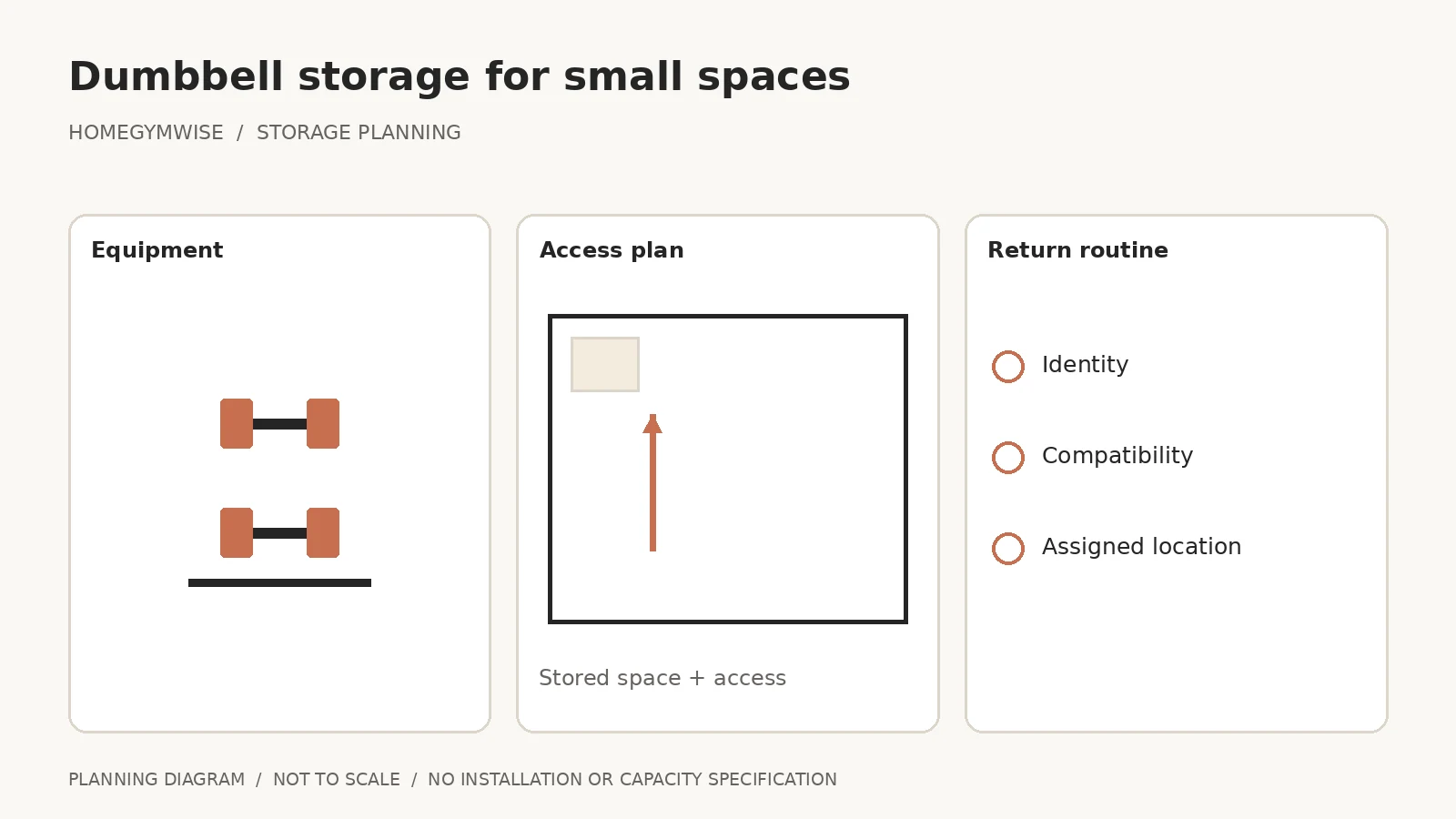
Choose storage around the dumbbells you actually use
Choose dumbbell storage around the weights you own and the way you retrieve them. A fixed-pair collection needs identifiable places for its pairs; an adjustable system may need its original bases retained and enough access to use its adjustment controls. Those are different storage tasks.
Start with compatibility and daily access, then compare the rack’s appearance or nominal floor footprint. A compact unit is a poor fit for your routine if another object blocks a handle or you have to move equipment every time you return a pair.
This is a storage-format guide, not a rack load-rating table or a dumbbell buying guide. Any capacity, assembly or support requirements belong to the actual equipment you are considering.
Measure the rack footprint and the lifting approach
Build the room sketch from an inventory of the actual pairs or adjustable units.
- List each pair or unit, its identity and weight. Keep future purchases in a separate list.
- Record the contact shape and dimensions that matter to the candidate storage format. A weight label alone does not establish cradle compatibility.
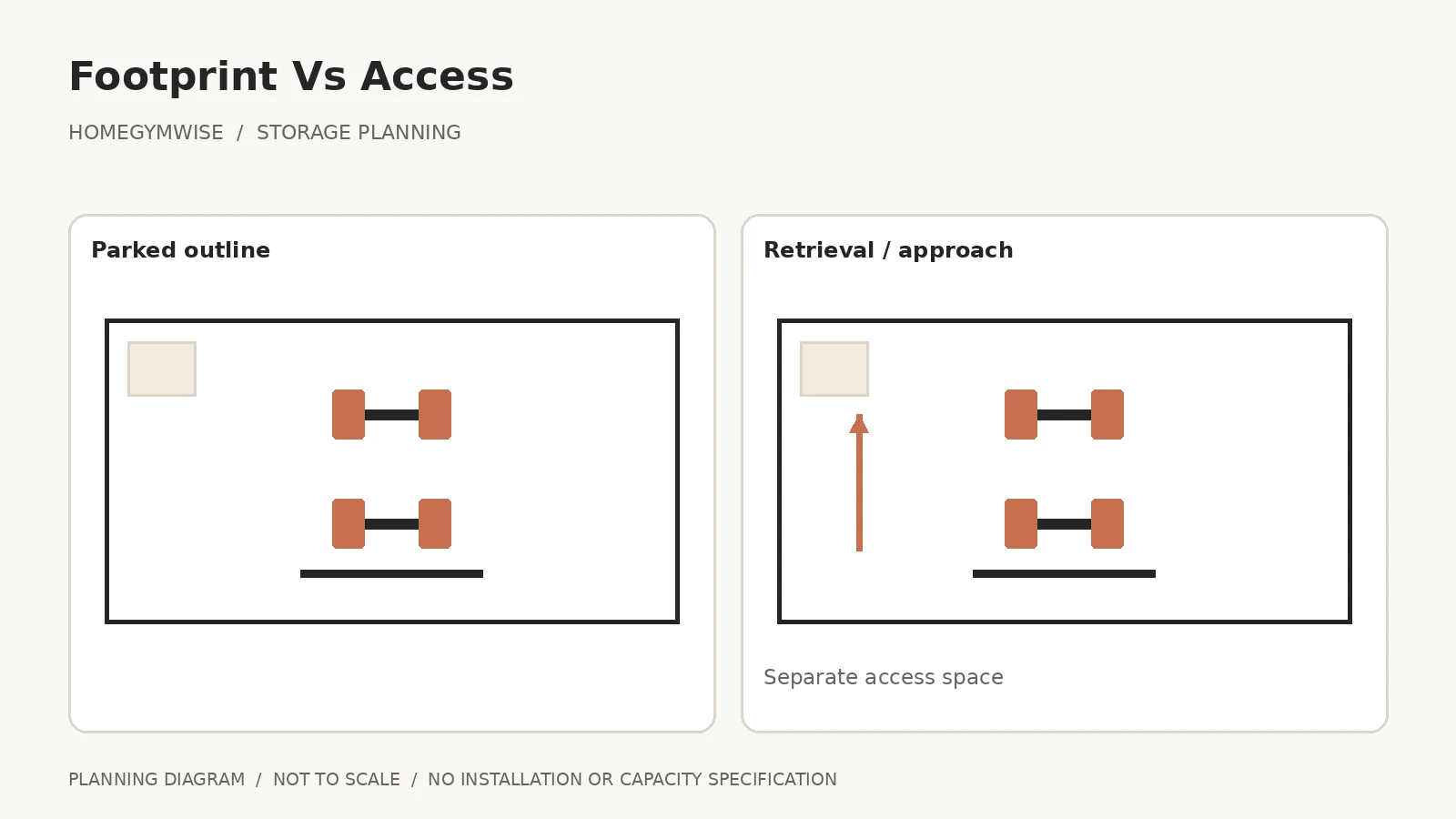
- Draw the unit’s full base or footprint, including any part extending beyond its shelves.
- Add the approach needed to reach the handles and return the weights. For adjustable units, include access to the bases and controls.
- Check the arrangement with nearby furniture in its normal position.
Imagine a rack alongside a sofa: its base may fit the gap while the sofa arm obstructs the lowest pair. That is an access problem even though the footprint fits. Compare a different orientation or location on the sketch before changing the rack format.
Do not turn this planning sketch into a prescribed lifting height or a universal clearance dimension; actual equipment requirements remain separate.
Compare a rack, vertical tower and adjustable-dumbbell stand
Use a comparison that explains what you need to reach and return.
| Format | Main planning question | What changes the decision |
|---|---|---|
| Horizontal multi-tier rack | Can you identify and reach every intended pair? | A tier blocked by furniture or another pair may make a different layout more useful |
| Vertical pair-storage format | Do the actual base and retrieval paths fit? | A compact-looking outline is insufficient if handles or lower locations are hard to access |
| Adjustable-dumbbell stand | Are the bases and adjustment controls supported as intended? | Exact system compatibility matters more than a generic shelf or nominal size |
A vertical arrangement can be a candidate for a small room, but measure its real base instead of assuming it occupies less usable space. Similarly, a stand that presents an adjustable unit conveniently is not automatically compatible with another generation or brand.
Use the same inventory and room sketch for each candidate so the comparison reflects your equipment, rather than three unrelated product descriptions.

Check compatibility before loading a storage unit
Confirm the storage unit’s exact compatibility, assembly, rated capacity and surface requirements before loading it. Include individual shelf or position restrictions if its documentation provides them; an overall rating is not permission to distribute weights however you like.
The BowFlex SelectTech stand guide is a useful documentation example: it distinguishes base attachment and assembly for the listed dumbbell variants. It does not establish compatibility for an arbitrary adjustable dumbbell or recommend those products.
Retain the bases where the actual system requires them. Avoid replacing a documented attachment with an improvised shelf arrangement. After assembly, use the manufacturer’s inspection requirements; do not load equipment onto a visibly damaged or unresolved storage setup.
If the candidate’s compatibility cannot be confirmed, keep it off the usable shortlist rather than treating approximate physical fit as approval.
Organize pairs so returning them stays simple
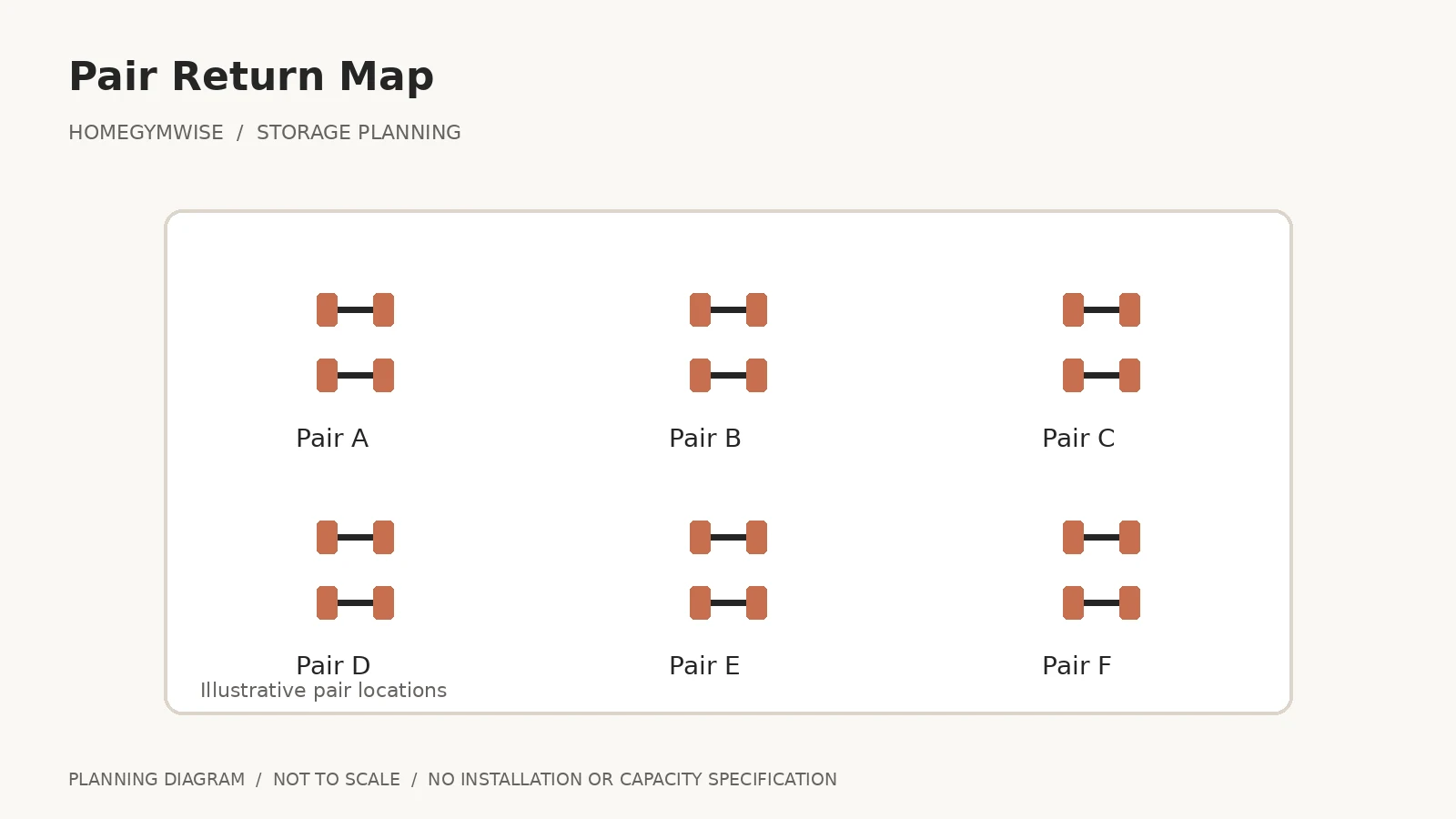
Assign a return location to each compatible pair or unit. The labels can be simple weight/identity labels; their purpose is to make returning the intended equipment straightforward, not to create a decorative rack that is inconvenient to use.
Keep empty future locations visibly separate from the current inventory. An empty cradle or shelf area does not prove that a new shape or heavier pair is permitted. Review the unit’s documentation when the collection changes.
Before settling on the arrangement, check the everyday sequence: approach, identify, retrieve, use and return. If one step requires shifting furniture, compare another location while the plan is still on paper.
For organizing the rest of the room, see the home gym storage ideas overview. Finish this decision with a compatible storage format and an accessible return plan for your actual dumbbells.


2 Comments