Fixed Dumbbells for Small Spaces: Choose Pairs That Fit Your Room

A practical set of fixed dumbbells is the collection of pairs you need whose verified storage and pickup arrangement fits your room. There is no universal pair count: the right collection depends on your established needs, the dimensions of each pair, compatible storage and the space available to use it.
This guide assumes you have already chosen fixed dumbbells. If you are still deciding between adjustable and fixed dumbbells, settle that category decision first.
Start with a pair ledger. Then check the collection and its storage together, including what changes when you add another pair.
Choose the pairs you need before choosing a bundle
Choose your initial pairs from needs you have already established. A bundle should be compared with that list, rather than becoming the list simply because it includes more dumbbells.
A matched pair contains two fixed dumbbells of the same nominal weight. Record each pair separately so you can distinguish what you need now from what you would merely have room to purchase.
Use this pair ledger as an editorial planning tool. It does not prescribe weights, exercises or a training plan.
| Ledger entry | Pair identity from your established needs | Reason for including it | Purchase decision |
|---|---|---|---|
| Needed now — repeat for each required pair | UNKNOWN | UNKNOWN | Include only after fit checks |
| Defer — repeat for each uncertain pair | UNKNOWN | UNKNOWN | Leave out of the initial purchase |
| Next addition | UNKNOWN | UNKNOWN | Recheck compatibility and space before adding |
Replace UNKNOWN with information you can confirm. Add rows to match your actual list; the worksheet does not suggest a target collection size.
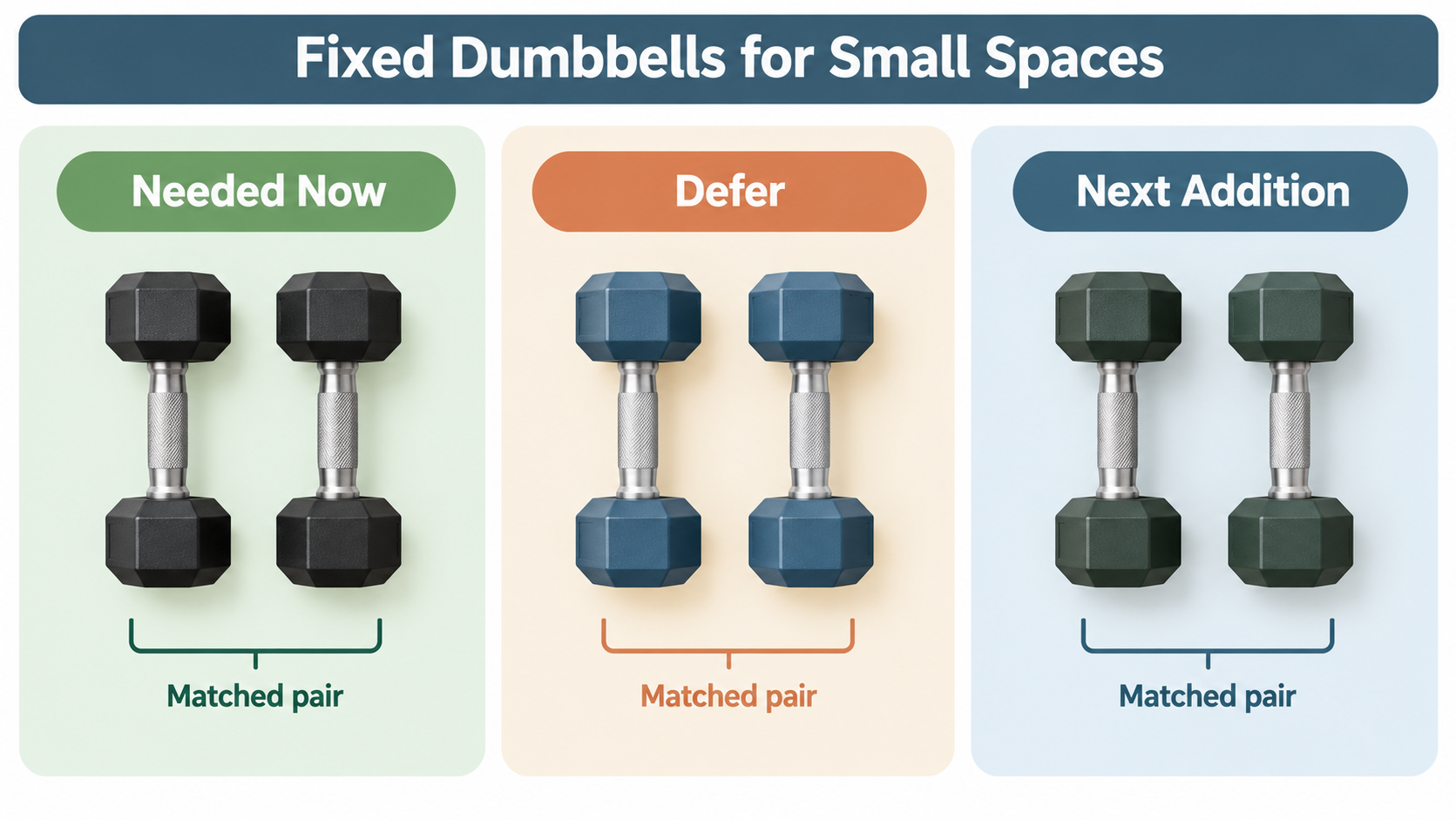
When comparing a bundle with individual pairs, mark every included pair against the ledger. A broader bundle may cover established needs, but it may also commit you to storing pairs you would otherwise defer. Buying pairs gradually lets you postpone those decisions, although each later addition still needs its own fit check.
Include compatible storage in the purchase budget. Check whether it is included, sold separately or unsuitable for the selected dumbbells. A collection that fits your equipment budget but leaves no allowance for suitable storage is an incomplete purchase plan.
Check what the set includes and how each pair fits
Read the contents list before relying on the advertised set count. Confirm whether the quantity describes individual dumbbells, matched pairs or a package that also includes storage.
Then check geometry and load separately. A stated pair count or load limit does not establish that your selected dumbbells fit the storage positions. Manufacturer compatibility information can depend on both dumbbell shape and the particular weight variant; broad compatibility wording needs to be checked against any exceptions.
For every selected pair, confirm:
- Contents: Two dumbbells of the same nominal weight are included.
- Exact variant: The dimensions apply to the item you intend to order.
- Head dimensions: The head shape and dimensions are documented.
- Handle dimensions: Handle length and thickness are documented.
- Rack fit: The manufacturer confirms compatibility with that exact variant.
- Storage positions: The selected pairs have usable, compatible positions.
- Load limits: The planned collection meets the stated total and per-tier limits, where specified.
- Included storage: Any bundled rack passes the same checks as separately purchased storage.
Use current manuals or manufacturer support to resolve missing information. If a listing makes a broad compatibility claim but another part excludes a relevant variant, keep the fit result UNKNOWN until the manufacturer clarifies it.
Keep a record of the supporting document or response beside each result. This makes it easier to distinguish confirmed fit from an assumption based on a photograph.
Compare the rack base with the space you will use
Check the full rack base and the space needed to approach it as two separate outlines. Rack selection requires distinct checks of compatibility, total load, footprint and access; passing one does not settle the others.
Rack footprint is its full external base outline; access space is considered separately. Include projecting feet and other parts that extend beyond the shelves. Do not substitute shelf dimensions for the complete footprint.
Use this two-envelope sketch method:
- Draw the equipment base. Use the manufacturer’s confirmed external dimensions, including projections.
- Mark pickup and return access separately. Assess where you would stand, reach and move while handling each selected pair.
- Compare both outlines with the room. Check nearby furniture, door movement and routes used during everyday activities.
- Record unresolved conflicts. If access depends on moving furniture, include that recurring task in your purchase decision.
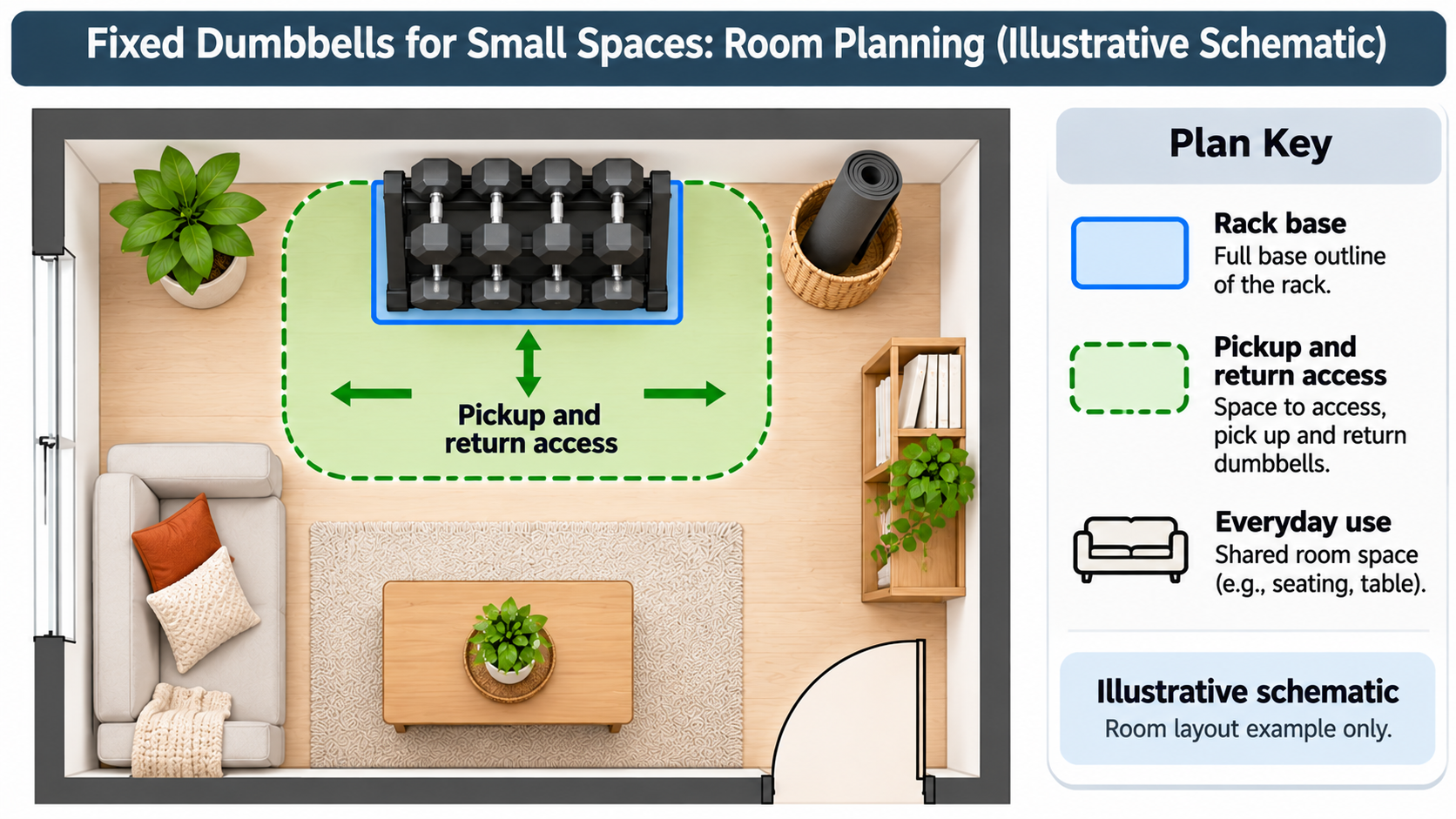
There is no universal amount of extra access space in this worksheet. The required arrangement depends on the rack, the selected dumbbells and your handling needs.
Compare rack formats using both outlines. A vertical arrangement may suit the available base area, but its storage positions still need a reach and access check. A wider arrangement must also fit the room’s everyday use. Neither format passes simply because its advertised footprint looks small.
Leave unverified dimensions marked UNKNOWN. This sketch helps assess room fit; it does not establish structural floor capacity.
Check pickup and return handling before buying
A pair can have a compatible storage position yet remain awkward for you to reach. Treat handling as a purchase filter alongside physical fit.
Where possible, assess the intended arrangement in person using the relevant rack and dumbbell variants. Otherwise, use verified dimensions, clear manufacturer documentation and targeted questions to identify what remains unresolved. A photograph alone cannot confirm comfortable handling.
Check each selected pair against these questions:
- Can you reach the handle without neighboring dumbbells obstructing your hand?
- Is the storage position within a reach you can manage?
- Can you approach and leave the rack without squeezing around furniture?
- Can you pick up and return the pair without relying on a position that feels awkward?
- Would access remain practical when all planned positions are occupied?
- Can each delivered item be moved through the route into the room, given its documented dimensions and weight?
Record an uncertain handling result as UNKNOWN rather than treating rack compatibility as proof of comfort.
Also compare the collection with how the room is used. If every session would require moving household furniture, decide whether that routine is manageable before ordering. Room fit includes the effort needed to make the equipment accessible.
Follow the manufacturer’s assembly and loading instructions. A successful handling check does not replace those instructions or approve the floor beneath the equipment.
Plan the next addition before filling the rack
Before committing to the initial collection, run the next proposed pair through the same checks. An empty position is not proof that another pair will fit or that the rack has sufficient remaining capacity.
Use this growth checkpoint to compare the current purchase with the next addition.
| Check | Initial collection | Collection with next proposed pair |
|---|---|---|
| Selected pair identities and quantities | UNKNOWN | UNKNOWN |
| Exact head and handle dimensions | UNKNOWN | UNKNOWN |
| Manufacturer-confirmed compatibility for every variant | UNKNOWN | UNKNOWN |
| Usable storage positions | UNKNOWN | UNKNOWN |
| Combined dumbbell weight | UNKNOWN | UNKNOWN |
| Compliance with total and per-tier limits, where specified | UNKNOWN | UNKNOWN |
| Full external rack footprint | UNKNOWN | UNKNOWN |
| Pickup access and hand clearance | UNKNOWN | UNKNOWN |
| Additional or replacement storage required | UNKNOWN | UNKNOWN |
| Effect on everyday room use | UNKNOWN | UNKNOWN |
Do not assume storage growth will be linear. Adding one pair might use an existing compatible position, require different storage or make access impractical. Determine the result from the exact proposed combination.
Keep total stored weight visible in the worksheet, but do not treat compliance with a rack limit as structural floor approval. Those are separate questions.
Future capacity also has a present cost in room space. Compare storage for your confirmed initial collection with storage for a defined next addition. Avoid occupying more of the room solely for an unspecified future set.
If the next pair has no established purpose, leave it deferred. You can revisit the worksheet when the need becomes clear.
Use a set-and-storage checklist before ordering
Complete a set-and-rack fit check before ordering.
- The contents list distinguishes individual pieces from matched pairs.
- Every initial pair has an established purpose.
- Exact dimensions and manufacturer-confirmed rack compatibility are recorded.
- Usable positions and applicable load limits are confirmed.
- The full base and separate pickup access fit everyday room use.
- Handling and delivery-route questions are resolved.
- The budget includes compatible storage.
- The next addition has been checked or deliberately deferred.
- No purchase-critical worksheet field remains UNKNOWN.
Proceed when the selected collection passes these checks. Reduce the initial set if fewer needed pairs resolve a fit problem and the revised combination is verified. Defer the order when compatibility, handling or another essential detail remains unresolved.
Once selection is complete, continue with Dumbbell storage for small spaces for the arrangement and storage-execution stage.