Small Apartment Workout Equipment: Choose by Space, Handling and Storage
Choose small apartment workout equipment by checking four constraints first: space during use, permission or attachment requirements, handling, and storage. Use those constraints to shortlist equipment categories, then verify exact models. A small packed size or a folding frame answers only part of the purchase decision.
If you still need to assess whether your apartment is ready for a workout setup, start with Small Apartment Home Gym Setup Checklist: Start With These First. This guide focuses on comparing equipment categories once those apartment conditions are understood.
Use the same apartment-fit criteria for every category
Separate space during use from storage configuration. Space during use includes the equipment, your movement, and any clearance required by its manufacturer. Storage configuration is the position or arrangement the manufacturer permits when the equipment is put away.
Delivery and routine movement also need separate checks. Equipment that a delivery team can assemble inside your apartment may still be impractical for you to move before each workout.
Use the same questions across your shortlist:
| Category | Operating-space questions | Permission dependencies | Handling questions | Storage method to verify | Reason to defer |
|---|---|---|---|---|---|
| Resistance bands | Where will you stand and move? Does the intended use require an attachment? | Any attachment needs a suitable, permitted support. | Can you manage the complete setup and removal sequence? | Exact-product care and storage instructions | The required attachment or product instructions remain unverified. |
| Fixed dumbbells or kettlebells | Is there room to pick up, use and put down the equipment? | Check applicable building conditions; category alone establishes no permission. | Can you handle each item between its storage location and use area? | A suitable storage arrangement for the exact equipment | Handling or storage access remains unresolved. |
| Adjustable dumbbells | Is there room to use the equipment and access its adjustment or docking arrangement? | Check applicable building conditions. | Can you follow the model’s adjustment, lifting and return instructions? | Manufacturer-approved base or storage arrangement | Exact-model instructions or applicable recall status remain unresolved. |
| Suspension equipment | Is the required movement area available around the attachment? | Compatible support and permission must both be verified. | Can you install, check and remove it as instructed? | Product-specific storage after removal | The door, frame, wall or anchor has not been verified. |
| Cardio machines | Does the exact model’s operating area fit, including required clearances? | Check building conditions and any relevant power requirements. | Can the machine stay in place, or must it move each session? | Exact-model folding, separation or storage orientation | The use area, moving route or permitted stored configuration does not work. |
| Mats, benches and attachments | What additional deployed space does the accessory require? | Attachments may introduce new permission conditions. | Can you deploy and store the accessory as instructed? | Product-specific storage and compatibility requirements | The accessory adds an unresolved dependency without solving a defined need. |
Write UNKNOWN beside any field you cannot verify. Do not turn an unknown into a favorable assumption because a product is described as compact, portable or apartment-friendly.
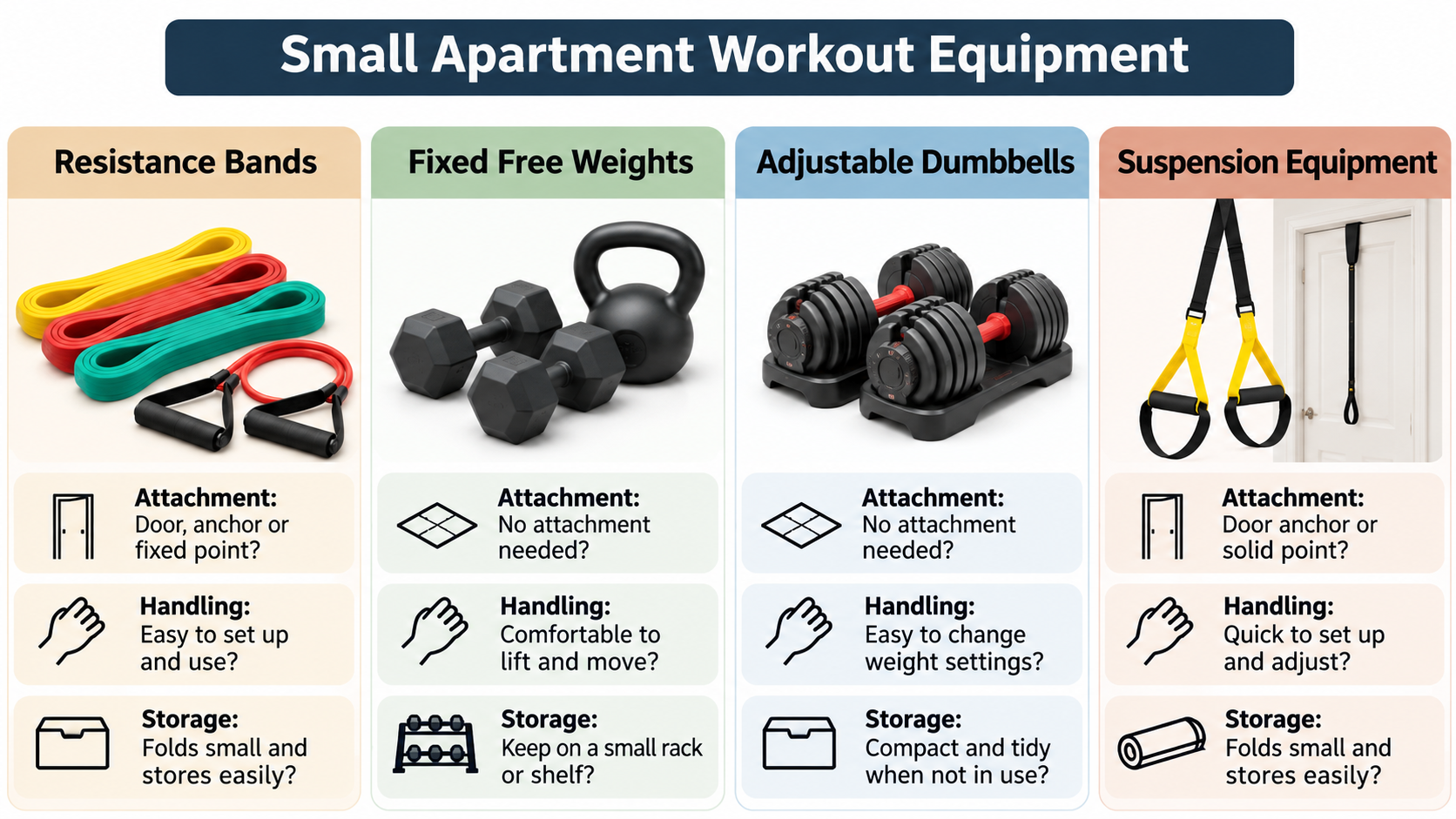
Compare bands, free weights and suspension equipment
A resistance category belongs on your shortlist only if its setup and storage requirements work in your apartment. Packed size alone cannot establish that fit.
| Category | What to verify | What would rule it out |
|---|---|---|
| Resistance bands | The exact product’s intended use, attachment requirements, condition checks, material information, care and storage instructions | The intended setup requires an attachment you cannot verify, or essential instructions are unavailable. |
| Fixed dumbbells or kettlebells | Handling suitability, access to the storage location, and enough room to retrieve and return each item | You cannot manage the equipment through the full storage-to-use sequence, or the storage arrangement remains unresolved. |
| Adjustable dumbbells | Adjustment and locking instructions, base access, handling requirements, exact model and applicable recall status | Recall applicability is unresolved, required checks cannot be completed, or the model’s handling and storage requirements do not fit. |
| Suspension trainers | The exact attachment system, compatible support, required use area and permission conditions | The support is incompatible, damaged, unverified or not permitted. |
Bands deserve particular attention when their intended use depends on a door or another attachment point. Check the actual product instructions before deciding that an attachment will work. A removable anchor does not establish that your door or frame is suitable.
Fixed and adjustable weights need a realistic handling check. The category label cannot tell you which weight is suitable for you to lift or carry. Include retrieval and return in the decision: equipment stored in an awkward location may create a handling problem before the workout begins.
For adjustable equipment, check recall information against the exact model and any identifying details specified in the notice. An unresolved recall question is a reason to pause. Finding no applicable notice does not establish universal safety.
Suspension equipment can depend on a compatible attachment even when its packed form fits inside a cupboard. If attachment suitability is unknown, leave the category off your purchase shortlist until that question is resolved.
Compare cardio equipment by usable space and moving method
A cardio machine needs two separate answers: where it will operate and where it will remain between sessions. If those locations differ, the moving method becomes part of the purchase decision.
| Category | Floor occupation and operating clearance | Moving steps to verify | Power requirements to verify | Storage instructions to verify |
|---|---|---|---|---|
| Exercise bikes | Check the assembled footprint, access and manufacturer-required use area. If it stays assembled in place, assess that continuing floor occupation. | Exact-model transport instructions, any wheel arrangement, and assistance requirements | Whether the selected model needs power and what its instructions require | Whether any alternative stored configuration is permitted |
| Walking pads or treadmills | Check operating dimensions and all required clearances separately from folded or advertised storage size. | The full folding or moving sequence, handling points and any restrictions | The exact model’s supply and connection requirements | Permitted orientation, folding configuration and storage conditions |
| Rowers | Check the assembled use area and access around the machine. | Whether the model rolls, folds, separates or uses another documented method | Any requirements for the selected model | The manufacturer-permitted configuration and orientation |
Do not treat folding, rolling and separating as interchangeable features. Each describes a different action, and none establishes that you can carry the machine.
A folding treadmill may still require a moving sequence that does not work along your route. A rower may have a documented separated storage configuration without permitting upright storage while assembled. Verify the instructions for the exact machine rather than transferring a storage method from another model.
For an exercise bike, determine whether it can remain in its operating location. If it must move after each session, confirm the transport method and the space needed at both ends of the route. Bike stability and handling details remain model-specific.
Noise is a separate purchase constraint. Comparative noise performance is unknown without relevant evidence, and acceptability in your building cannot be inferred from a category name. If noise restrictions decide the purchase, keep the machine off the final list until you have evidence relevant to that model and your circumstances.
Add mats, benches or attachments only when they solve a defined need
Accessories belong in the comparison when they solve a specific problem. Check the dependency each one adds before including it in the setup.
- Yoga or exercise mats: Choose according to the intended activity and exact-product guidance. Portability can involve a cushioning tradeoff. A yoga mat is a separate category from a machine-protection mat; do not assume it protects flooring from weights or machinery.
- Equipment mats: Verify compatibility with both the equipment and the floor finish. A mat does not establish floor protection, soundproofing or acceptable noise transmission.
- Optional benches: Check deployed space, handling, storage instructions and any folding-lock requirements for the exact model. A bench needs its own place in the storage plan.
- Attachments: Verify the attachment, supporting structure and equipment compatibility together. Removal after use does not make an attachment automatically permitted or suitable.
Include required accessories in the total usable setup cost. Also check delivery, assembly, necessary services and recurring charges where applicable. Compare what the setup requires to function as intended, rather than the equipment’s advertised price alone.
If an accessory creates an unresolved mounting, storage or compatibility problem, defer it.
Build a shortlist around the constraint you cannot change
Start with the condition that would eliminate a purchase regardless of its other features. That condition might be a fixed storage location, a ban on attachments, a daily moving requirement or a building noise restriction.
The following are illustrative editorial examples, not guaranteed suitable equipment kits.
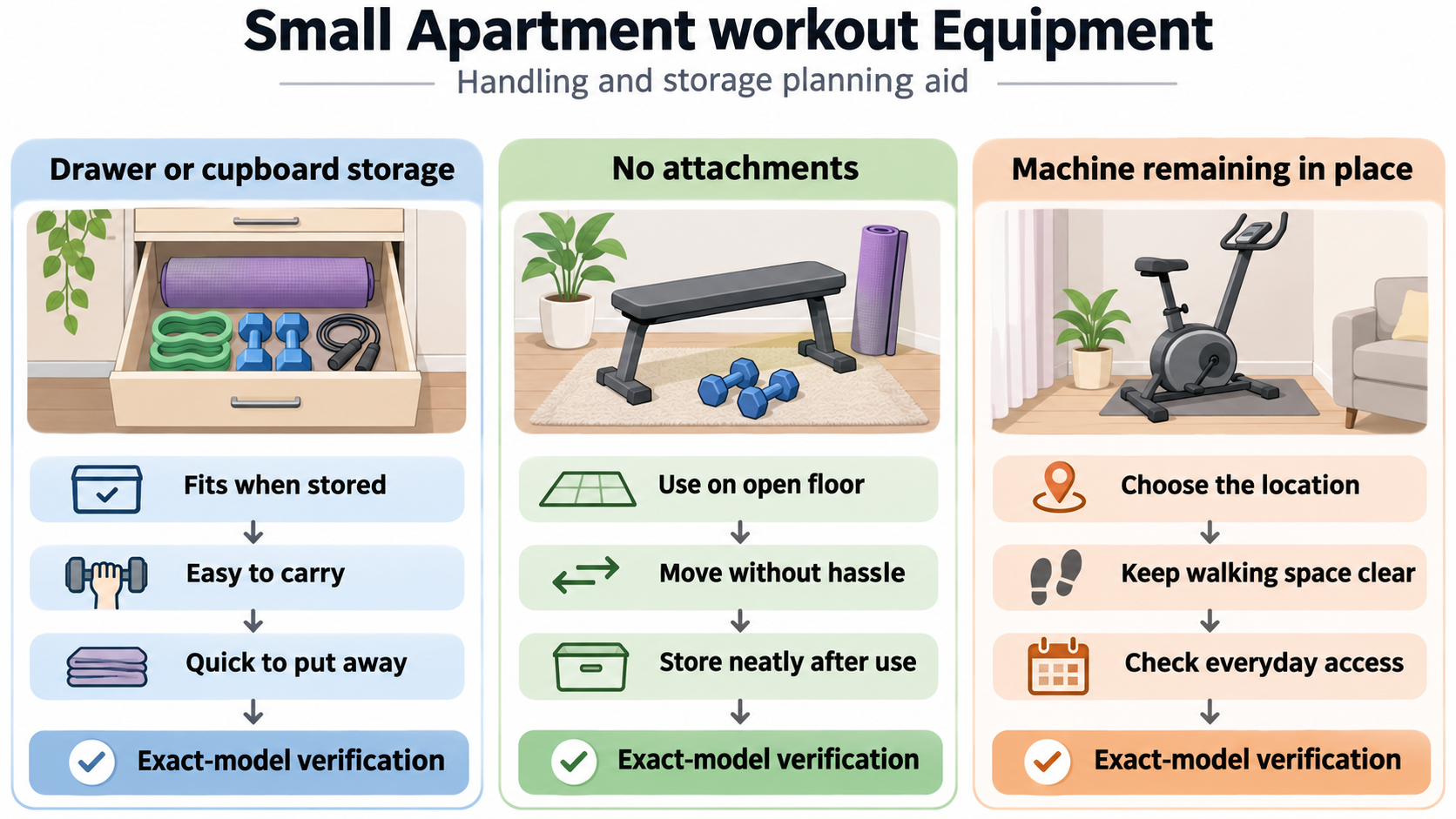
If everything must fit in a drawer or cupboard
Investigate bands or individual free weights only after checking the actual storage space, product instructions and handling requirements.
For bands, confirm that the intended use does not depend on an unresolved attachment. For weights, check whether retrieving and returning them is manageable from that particular storage location.
If an item fits inside the cupboard but cannot be handled conveniently from there, it has not passed the storage check.
If attachments are not an option
Defer equipment whose intended use requires an attachment you cannot approve or verify.
Unattached resistance equipment or a freestanding cardio machine may remain categories to investigate. Each still needs its own operating-space, handling and storage checks. “No attachment” does not answer building permission, structural adequacy or noise questions.
If a machine can remain in place
Compare exercise bikes, walking pads or treadmills, and rowers against the available operating area and exact-model requirements.
A machine that can stay in position avoids the need to move it into storage after every session. It still needs adequate clearance, access, any required power connection and acceptable building conditions.
If the machine cannot remain there, require a documented stored configuration and a workable route before keeping it on the shortlist.
If noise restrictions decide the purchase
Pause any choice that depends on an unsupported quietness assumption. Ask for relevant model evidence and clarify the building’s conditions before proceeding.
The practical sequence is: identify the fixed constraint, remove categories with unresolved dependencies, then investigate exact models within the remaining categories.
Check the full route from delivery to storage and use
Before ordering, follow the equipment’s planned route through your apartment without moving an unknown load. Measure and inspect the route using the seller’s delivery information and the manufacturer’s documentation.
Check each stage separately:
- Delivery service: Where does the service end? Confirm whether it includes entry into the building, stairs, placement, unpacking or assembly.
- Shipping configuration: Obtain the packaging information relevant to access. Do not substitute assembled dimensions for shipping dimensions.
- Doorways and corridors: Check the route to the assembly and use locations, including turns and other restrictions.
- Assembly: Confirm the required process, assistance and space before delivery.
- Routine movement: Read the exact instructions for moving equipment between storage and use. Identify any folding, separation or assistance requirements.
- Storage access: Confirm that you can reach the storage location and retrieve the equipment in its permitted configuration.
Do not experimentally carry heavy equipment to find out whether the route works. Your carrying ability and the equipment’s handling demands remain unresolved until assessed appropriately for the actual situation.
Wheels do not establish stair-delivery suitability. Likewise, successful delivery does not prove that daily movement will be manageable. If the delivery team can place a machine in the room but you cannot follow its routine moving instructions, reconsider a purchase that depends on moving it after every session.
Verify the exact model before making the final purchase
Use the category comparison to narrow your research. Make the final decision against the exact model, variant and seller’s offer.
| Final check | What you need before proceeding |
|---|---|
| Model identity | Exact model and variant, with the current applicable manual |
| Recall applicability | A check against the model and identifying details required by any relevant notice |
| Space during use | Documented dimensions and required clearances that work in the intended location |
| Storage | A manufacturer-permitted configuration and accessible storage location |
| Handling | Instructions you can follow for delivery, assembly and routine movement |
| Permission and attachments | Resolved building conditions and verified compatibility wherever an attachment is involved |
| Power, where applicable | Confirmed model requirements that can be met at the intended location |
| Noise constraints | Relevant evidence where noise acceptability is decisive; no category-wide assumption |
| Accessories and total cost | Verified compatibility and a list of required setup items, services and recurring charges |
| Seller’s terms | Delivery scope, return conditions and costs, warranty terms and applicable exclusions |
Defer the purchase if a decisive field remains UNKNOWN. This includes anyone relying on an unverified anchor, an undocumented storage orientation, an unresolved moving requirement or a noise assumption their building conditions do not support.
Choose the candidate whose requirements you can verify and meet. If none clears those checks, keep the shortlist open.