Compact Elliptical Exercise Equipment: Check Room Fit Before Buying
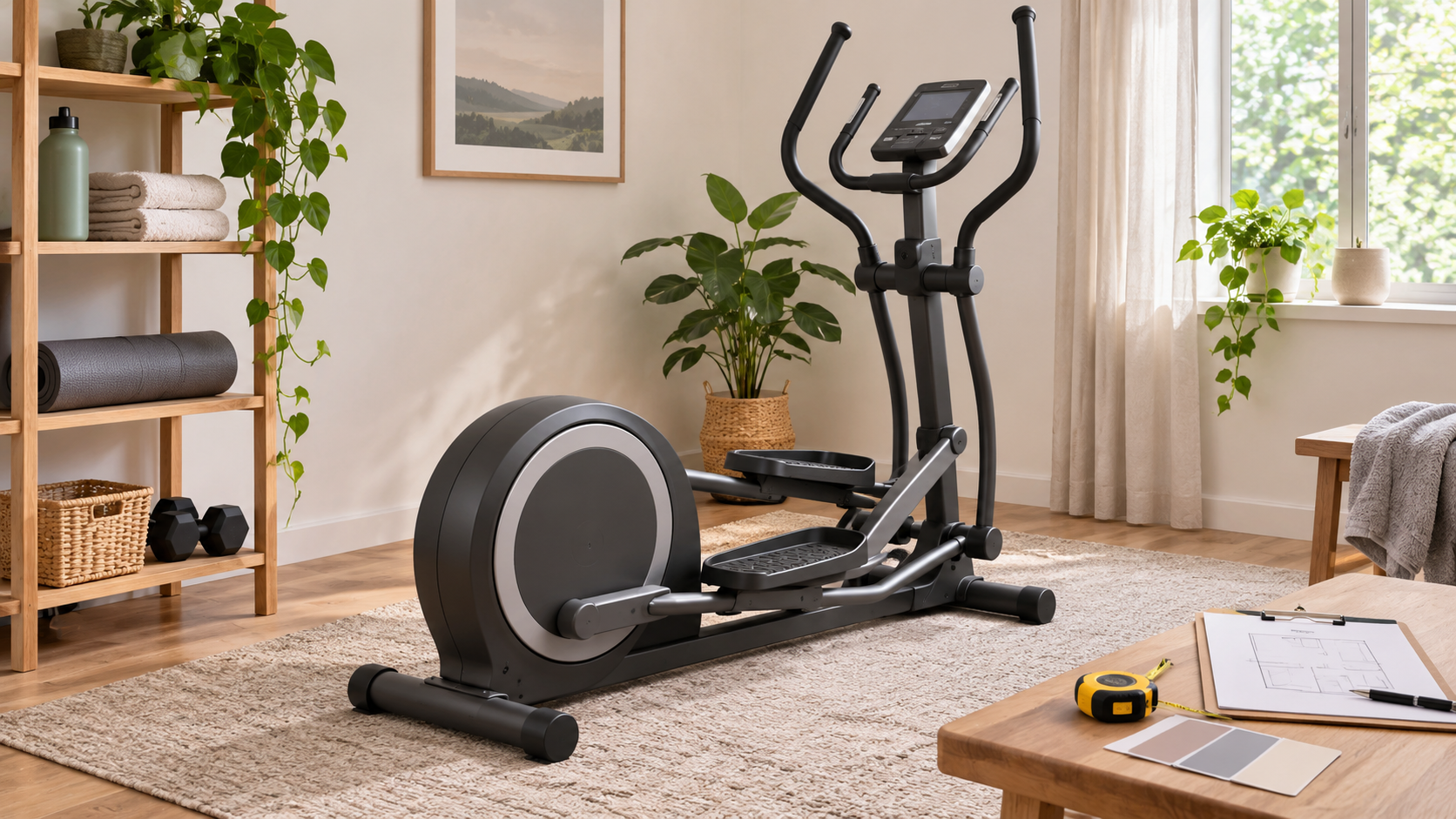
Compact elliptical exercise equipment may fit a small room, but the listed dimensions alone cannot settle the decision. Check the exact standing model’s operating space, your movement on the machine, and how it will reach its intended position.
Start with the current manufacturer’s documentation. Use it to assess moving parts, required free space, overhead room, access, storage, and handling. If a consequential requirement is missing, request clarification before ordering.
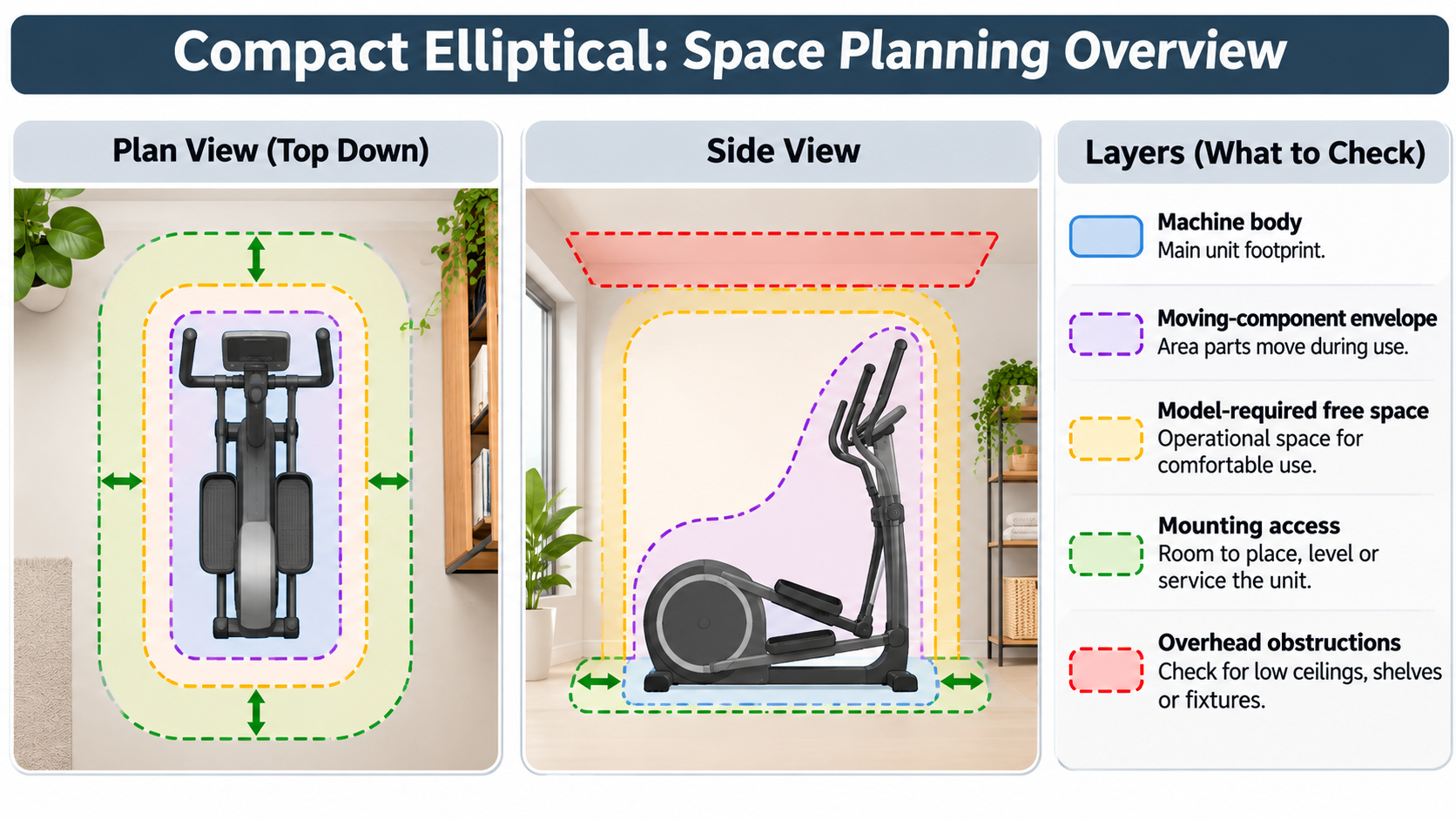
Separate the listed footprint from the space needed in use
Treat “compact” as a description to investigate. A small elliptical machine still needs an assessment of its full movement and the space around it.
A specification labeled “dimensions” does not necessarily describe every position of the pedals or handles. Establish what the measurement includes before marking it on your floor.
| Field | What it means | What to establish |
|---|---|---|
| Listed footprint | Dimensions supplied for the exact model, with their meaning verified | Whether the figures describe the assembled machine and which parts or positions they include |
| Moving-component envelope | Space occupied by moving components through their documented permitted motion | The furthest pedal and handle positions during use |
| Manufacturer-required clearance | Free space required by the applicable model instructions | Where that space must remain available and how the manufacturer measures it |
| Mounting access | Space needed to get on and off the machine | Whether the intended approach remains accessible in your layout |
| Overhead requirements | Vertical space needed for the intended user through permitted movement | The model-specific information needed to assess ceilings and overhead obstructions |
Abt’s elliptical buying guide identifies overhead space, pedals extending beyond the machine, and step-up height as buying considerations. These are useful prompts for checking a model; they do not establish its exact room requirements.
Keep the fields separate in your notes. Do not assume required clearance starts at the machine body, or that a listed footprint already includes moving parts. Ask the manufacturer how its instructions apply.
Check the full operating area and overhead space
Assess the room as it will be used during a session, including furniture and household access.
- Record the usable area and fixed obstructions. Measure the intended location. Note walls, furniture, door swings, beams, ceiling fans, and other overhead objects. Include routes that other household members need to use.
- Obtain the machine’s full movement information. Look for documentation showing the furthest pedal and handle positions. If the assembled dimensions do not explain these positions, ask the manufacturer for a diagram or written clarification.
- Identify the exact model’s required free space. Follow the applicable manual’s clearance instructions. For example, the Sunny Health & Fitness SF-E905SMART manual v3.0 specifies at least 2 feet (60 cm) of free space all around that model. This is an illustrative manual requirement, not a recommendation for other ellipticals.
- Check overhead requirements for every intended user. Obtain the information needed to assess the user’s highest position through the permitted movement range. Step-up height is an access measurement; do not assume it equals maximum pedal elevation or establishes overhead fit. Include beams, fans, and other obstructions in the check.
- Review access with the machine in its operating position. Check getting on and off, opening doors, and moving through the room. A layout that accommodates the equipment still needs a separate assessment of household circulation.
If overhead information remains unclear, send the manufacturer your ceiling and obstruction measurements and ask what additional model information is needed. A standing-height measurement beside the machine does not resolve the question.
Check the stride, handle reach, and mounting access
Room fit and user fit are separate checks. A machine can occupy the available area while leaving questions about how a particular person moves on it.
SELF’s elliptical buying guide recommends assessing movement comfort, stride options, and handle reach, with an in-person trial where feasible. Comfort is specific to the user, so assess each person who plans to use the machine.
- Identify the stride information. Establish whether the stride is fixed or adjustable and what the documented settings mean. Do not select a stride solely from a height-based rule.
- Assess the movement path. During an appropriate trial, consider whether the permitted motion feels comfortable for that user. Record questions that a specification sheet cannot answer.
- Check handle reach. Assess the documented hand positions and moving handles, where fitted. Include reach throughout the movement rather than only while stationary.
- Include getting on and off. Check the intended mounting side, nearby furniture, and access to the model’s documented supports.
- Repeat the assessment for shared users. One person’s comfortable reach or stride does not establish another person’s fit.
If an in-person trial is unavailable, separate documented features from unresolved comfort questions. Ask the seller how a trial or return would work before relying on either option.
Verify the storage position and routine moving method
A compact label does not establish folding support, upright storage, or manageable daily movement. Each needs its own documentation.
| Question | Evidence to obtain | Assumption to avoid |
|---|---|---|
| Can the machine fold? | Explicit instructions for the exact model and configuration | Compact equipment must fold |
| Is another storage orientation supported? | Manufacturer instructions permitting that position | An unused machine can be stood on end |
| What space does storage require? | Documented dimensions for the approved storage configuration | Operating dimensions also describe storage |
| How is the machine moved? | Specified grips, tilt procedure, and wheel instructions | Transport wheels make any moving method acceptable |
| Does the route work? | Buyer measurements checked against the documented moving configuration | A route that fits the stationary machine also fits it during movement |
For example, the SF-E905SMART manual describes front transport wheels and an armrest-assisted tilting method. That procedure applies to that model. It does not establish one-person handling, stair suitability, or an approved method for another elliptical.
Before planning a move between sessions:
- Read the full documented moving procedure, including its prerequisites.
- Check the route between the operating and approved storage positions.
- Include turns, doorways, thresholds, and furniture in the assessment.
- Establish what assistance the documented procedure requires or leaves unresolved.
- Plan how the room will return to everyday use after the session.
Distinguish rolling from lifting. Wheels do not answer how a machine should be lifted or carried. For any lifting or stair movement, obtain confirmation from the manufacturer, seller, or mover about the exact machine and route.
If the intended storage position or daily moving method is undocumented, keep it unresolved rather than building the purchase around it.
Plan delivery and assembly separately from daily moving
Getting the machine into the home is a different task from moving it after assembly. Record packaged and assembled information separately.
The SF-E905SMART product page lists fields for product dimensions and weight, shipping dimensions and weight, and transport wheels. Those fields illustrate the information to collect; none alone establishes whether delivery will work in your home.
Before placing the order:
- Obtain packaged dimensions and shipping weight. Confirm the exact model and package configuration.
- Obtain assembled dimensions and product weight. Keep these separate from the shipping figures.
- Measure the delivery route. Include entrances, narrow points, turns, stairs, elevators, and access restrictions.
- Request the delivery scope in writing. Establish where the seller’s service ends and who handles any remaining route.
- Clarify assembly responsibility. Ask what assembly includes, where it occurs, and who removes packaging.
- Resolve stairs and restricted access. Describe the actual route to the seller or mover instead of assuming a standard service covers it.
- Confirm any proposed disassembly. Obtain model-specific approval and identify who will perform the work.
A useful written question is: “For this exact model and package, what will your service move, assemble, and remove at my address, and which parts of the route are excluded?”
Do not assume a standard crew size or that room-of-choice delivery is included. Resolve the handling arrangement before the machine arrives.
Confirm power requirements and the model’s intended use
Check power by component. Information about the console may not describe the resistance controls or other functions.
| Item | What to verify |
|---|---|
| Console or meter | Its documented power source and any required batteries or supply |
| Resistance controls | Whether adjustment is mechanical or powered |
| Other powered functions | Any separate supply requirements stated for the exact model |
| Mains connection, if applicable | Current US manufacturer electrical instructions |
| Intended users and limits | Applicable user requirements and limits in the manual |
| Use designation | Whether the documented use matches the planned residential setting |
| Environment | Required surface, indoor conditions, and storage restrictions |
| Building or rental permission | Applicable requirements from the owner, lease, or building management |
The SF-E905SMART manual provides a model-specific example: its meter uses two AAA batteries, and resistance is adjusted with a mechanical tension controller. This does not establish the power requirements of another compact elliptical.
That manual also specifies adult indoor home use, excludes commercial and therapeutic use, calls for a solid, flat, level surface, and warns against extreme or damp storage conditions. Check the equivalent instructions for the model you are considering.
For a mains-powered model, electrical requirements remain unknown until the exact current US instructions are obtained. Do not fill that gap with assumptions about outlets, circuits, grounding, or extension cords.
Room measurements also cannot establish floor structural suitability. A user-weight limit is not floor-load approval, and dividing equipment weight by its footprint does not provide structural approval. Building and rental permissions require a separate check.
Use a room-fit worksheet before placing the order
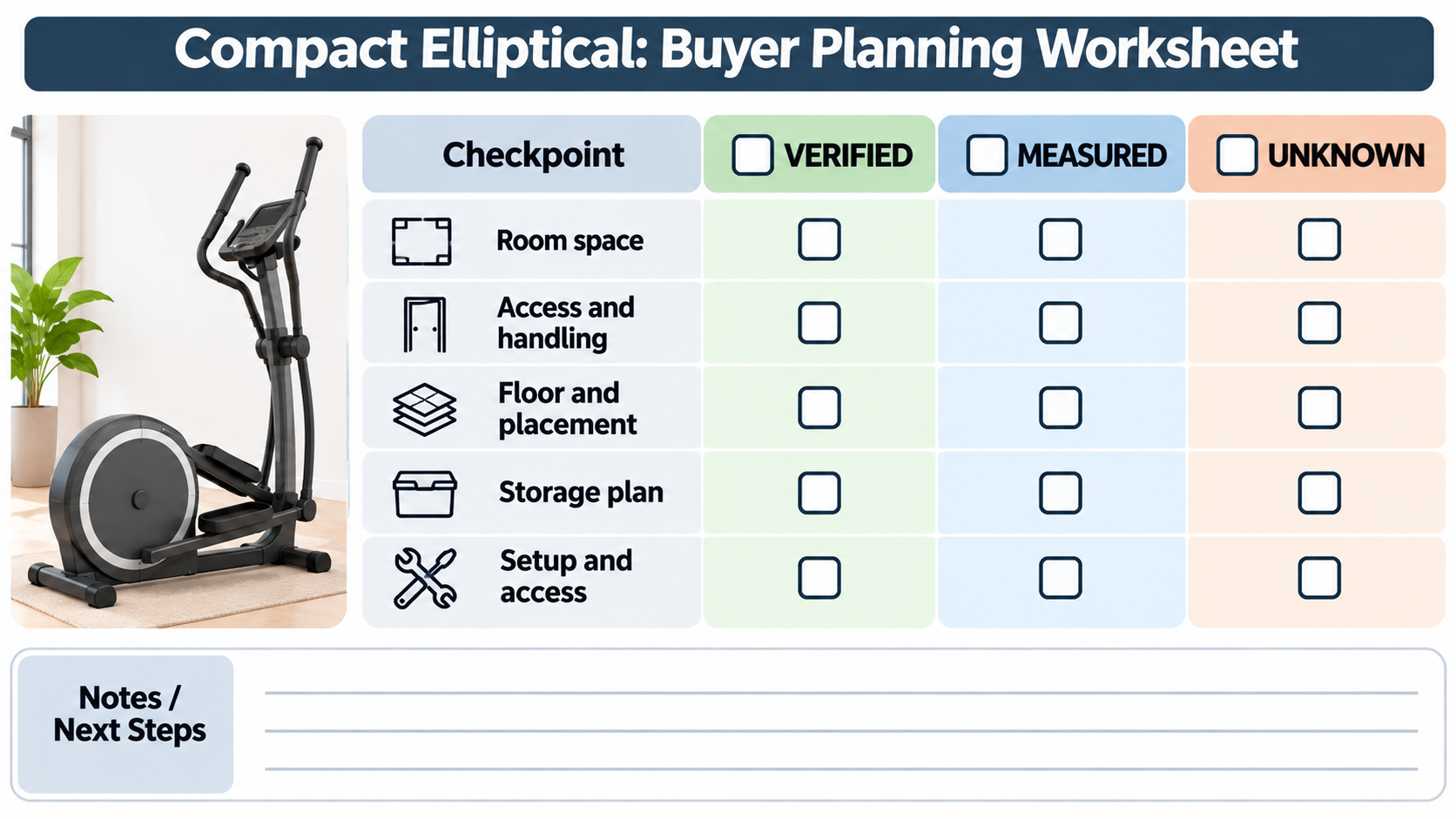
Use this worksheet as an editorial planning tool. Its completion is not safety certification, structural approval, or a guarantee of suitability.
Keep manufacturer facts separate from measurements you take at home:
- VERIFIED: A model fact supported by an identified document or written response.
- MEASURED: A room, route, or obstruction measurement recorded by the buyer.
- UNKNOWN: Information that is missing, unclear, or not yet reconciled.
| Criterion | Model fact and status | Source and model/manual revision | Buyer measurement | Unresolved question |
|---|---|---|---|---|
| Listed footprint and what it includes | ___ | ___ | ___ | ___ |
| Moving pedal and handle extents | ___ | ___ | ___ | ___ |
| Operating or service clearance, as applicable | ___ | ___ | ___ | ___ |
| Maximum user elevation and overhead requirements | ___ | ___ | ___ | ___ |
| Mounting access and door operation | ___ | ___ | ___ | ___ |
| Stride and handle suitability for each user | ___ | ___ | ___ | ___ |
| Approved storage position and dimensions | ___ | ___ | ___ | ___ |
| Documented moving method and route | ___ | ___ | ___ | ___ |
| Packaged size, weight, and delivery scope | ___ | ___ | ___ | ___ |
| Assembly and any approved disassembly | ___ | ___ | ___ | ___ |
| Component power and US electrical instructions, if applicable | ___ | ___ | ___ | ___ |
| Intended use, user limits, and environment | ___ | ___ | ___ | ___ |
| Floor suitability and applicable permissions | ___ | ___ | ___ | ___ |
Use the worksheet to choose the next action:
- A consequential requirement is unknown: Request the missing model information or property-specific confirmation. Leave the purchase decision open.
- A documented requirement conflicts with the room or route: Revise the proposed layout or handling arrangement, or remove that model from consideration.
- The documented requirements appear compatible with your measurements: Review unresolved user-fit questions and obtain written delivery and assembly terms before deciding whether to order.
Actual noise and vibration transmission in your dwelling remain unknown from this worksheet. It also does not establish any unverified product certification.
Send the manufacturer or seller your unresolved questions together, naming the exact model and manual revision. Request the missing movement, overhead, storage, or handling information before placing the order.