Storing A Folding Treadmill
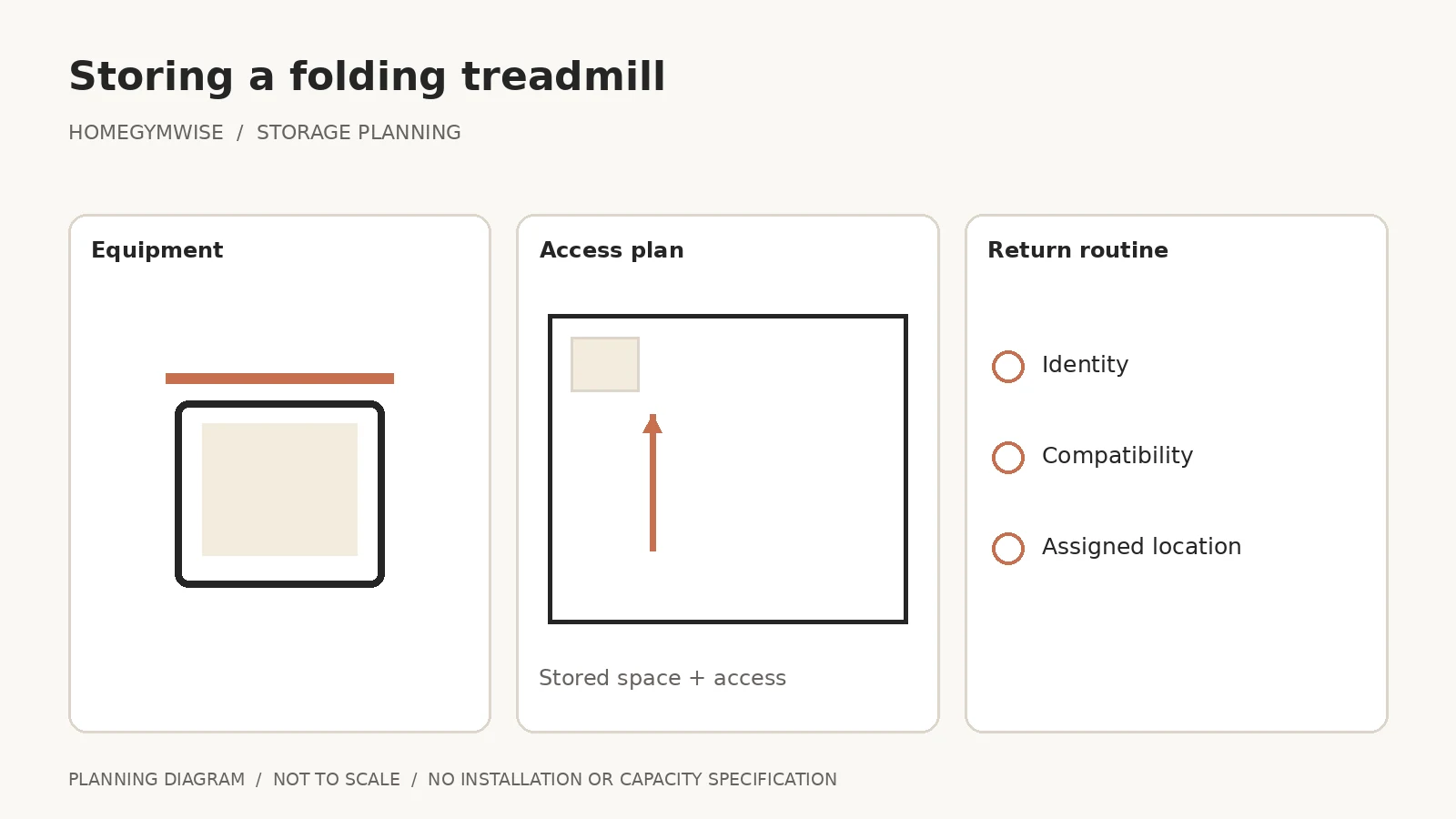
Plan storage around your treadmill’s approved configuration
A treadmill’s folding feature does not by itself approve every storage position or location. Plan around the configuration your equipment permits, then check whether the parked footprint and the route to it work in your room.
An upright folded deck, a flat stored unit and a nonfolding treadmill present different questions. Do not assume that vertical storage, under-bed placement or outdoor storage is allowed because the equipment looks movable.
This guide covers a generic storage-planning routine. It does not prescribe latch operation, wheel placement, lifting grips, electrical sequences or dimensions for an unspecified treadmill.
Check the parked footprint and the route to it
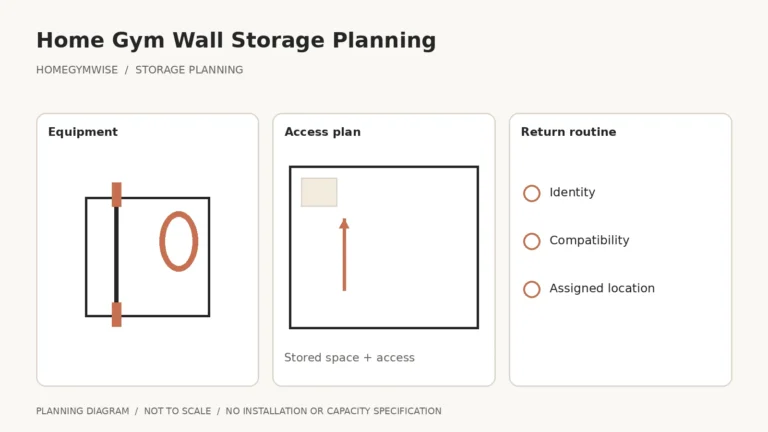
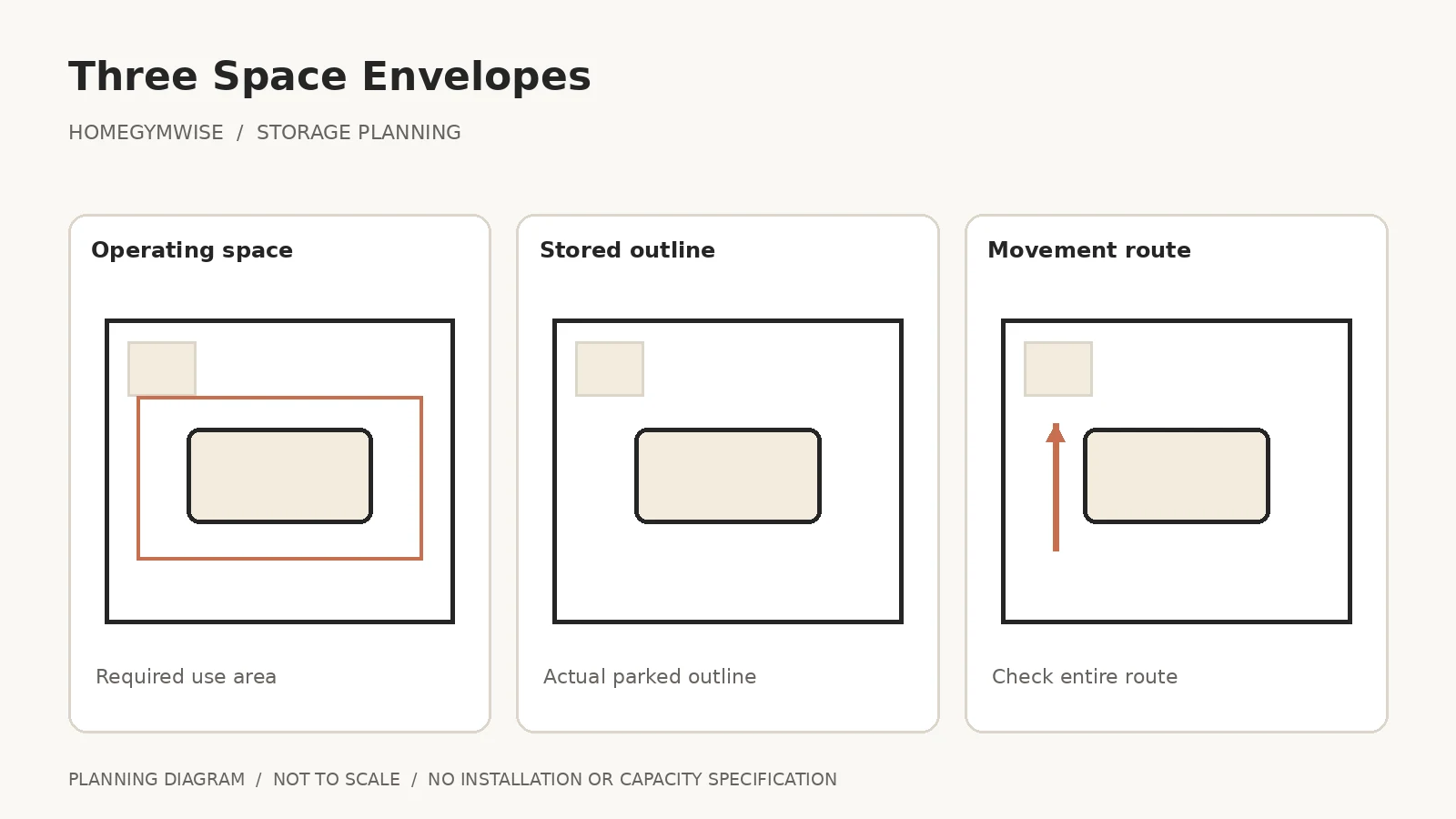
Separate three spaces on the room sketch: where the treadmill operates, where it will be stored and the route between them. A small parked outline does not answer whether the move is practical.
- Record the actual approved stored configuration and its dimensions.
- Mark the intended location with normal furniture and doors in place.
- Add the route through the room, including turns, thresholds and obstructions.
- Record the operating area separately, using the applicable equipment requirements.
- Identify any movement or assistance requirement you have not resolved.
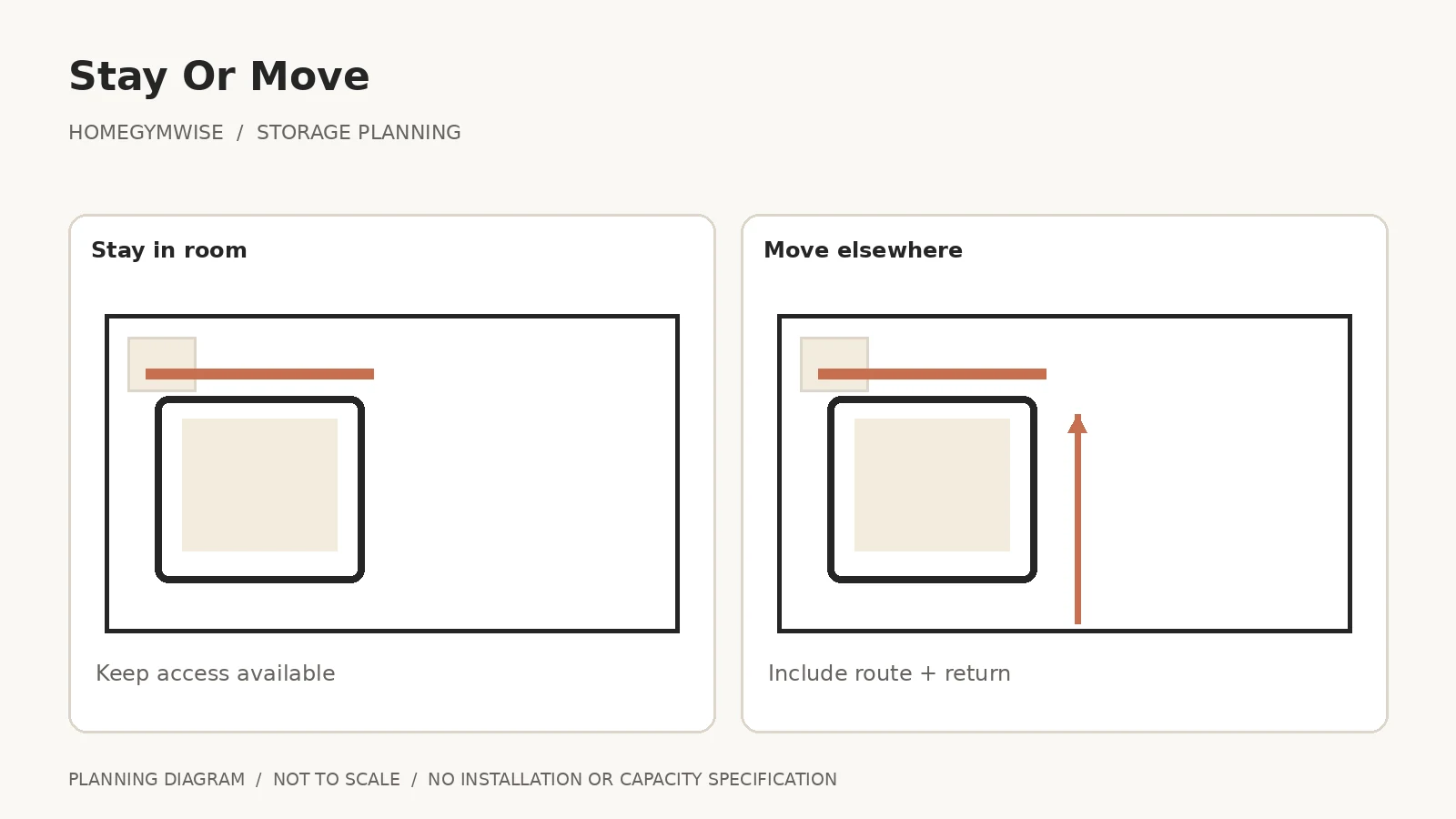
For example, moving the treadmill into a spare-room corner may recover space in the shared room but create a repeated handling task. Leaving it in an approved folded configuration in the original room may be a more practical candidate even if it occupies more visible space. Compare the complete routine, not just two footprints.
Do not infer that one person can complete the move or substitute a universal route-width allowance for actual requirements.
Prepare to fold or move without guessing the mechanism
Identify the manufacturer’s folding and movement process before handling the treadmill. Use it to resolve the approved configuration, sequence, contact points and assistance needs for your equipment. A generic storage guide cannot supply those missing details.
A representative Focus C1 manufacturer manual warns about hand pinching and keeping people and pets clear during lowering. It also has its own folding and transport instructions. The warning illustrates why the movement area matters; its pin positions and handling technique must not be transferred to another treadmill.
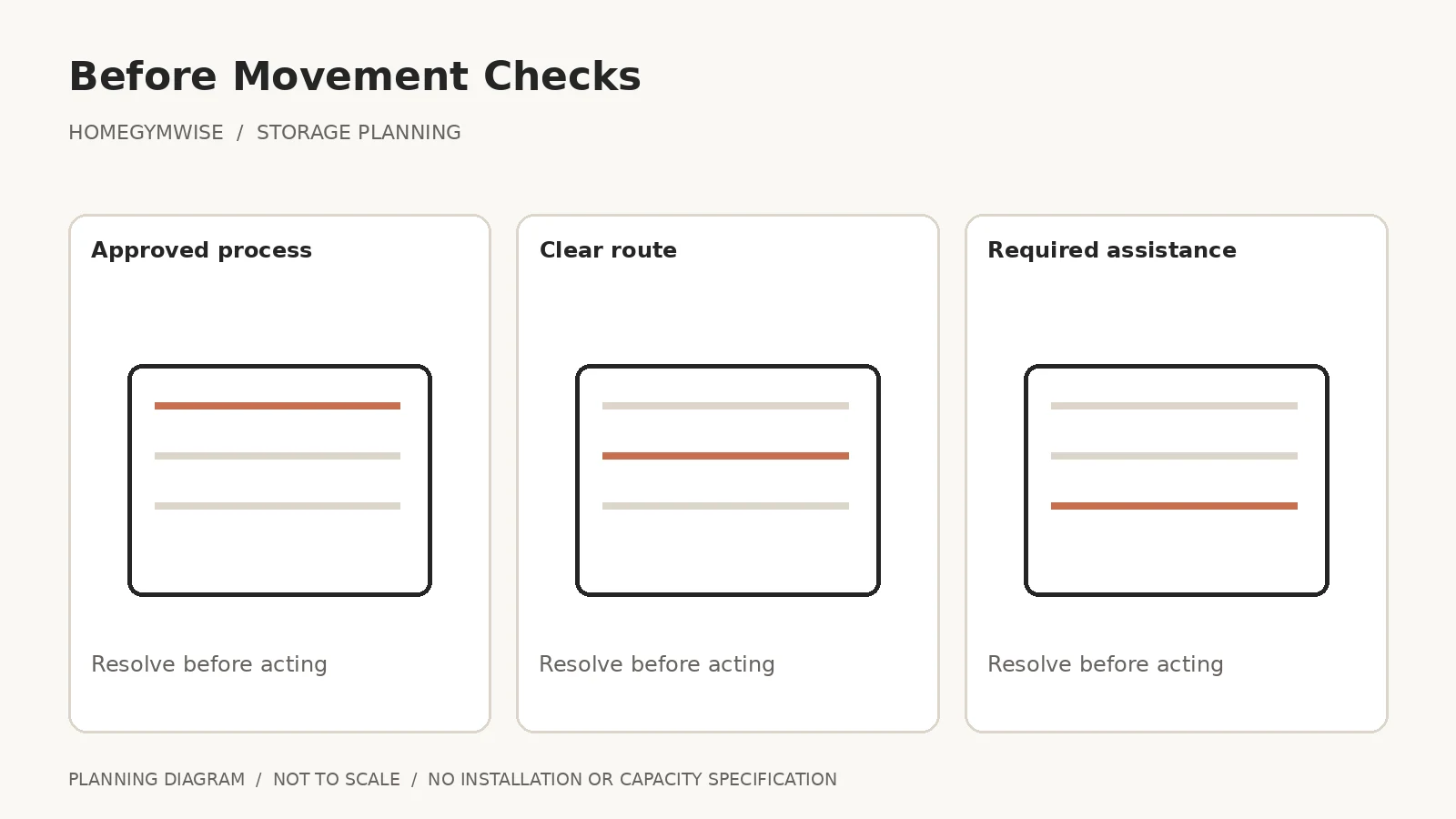
Before the move, confirm the route is available, people and pets can remain clear, and any required help is arranged. If the folding mechanism, movement method or assistance requirement is uncertain, stop that handling task and resolve it.
You can still compare storage locations on paper while those details are being checked; there is no need to improvise a folding technique to finish the room plan.
Choose a storage location that fits the manufacturer’s conditions
Evaluate the actual permitted orientation and environmental conditions before treating a location as suitable. Portability does not establish weather, humidity or outdoor suitability. This page gives no generic moisture rating or electrical recommendation.
| Storage plan | What to compare | When to pause |
|---|---|---|
| Keep it in the same room | Approved stored configuration, remaining access and everyday room use | The configuration or location is not permitted or blocks required access |
| Move it to another indoor location | Entire route, assistance, destination conditions and return routine | Any movement or destination requirement remains unresolved |
| Proposed under-bed, vertical or outdoor placement | Explicit applicability to the actual equipment | Appearance or available space is the only basis for approval |
A destination that looks spacious can still be inconvenient if every workout requires a difficult move back. Record the handling burden alongside the parked dimensions before choosing between locations.
Make the next setup part of the storage routine
Include return-to-use steps in the storage plan. Keep the required access available and record the applicable setup and inspection checks so the next session does not begin with a guess about how to restore the equipment.
Do not use the stored treadmill as a shelf or stack other equipment on it without applicable approval. If the room arrangement changes, review the route and destination again rather than assuming the original plan still applies.
For the broader storage of weights, bands and other equipment, see home gym storage ideas. Finish this treadmill decision with three recorded items: an approved stored configuration, a usable location and a documented movement/return process. Exact handling remains governed by the equipment’s own instructions.