Barbell storage for small spaces
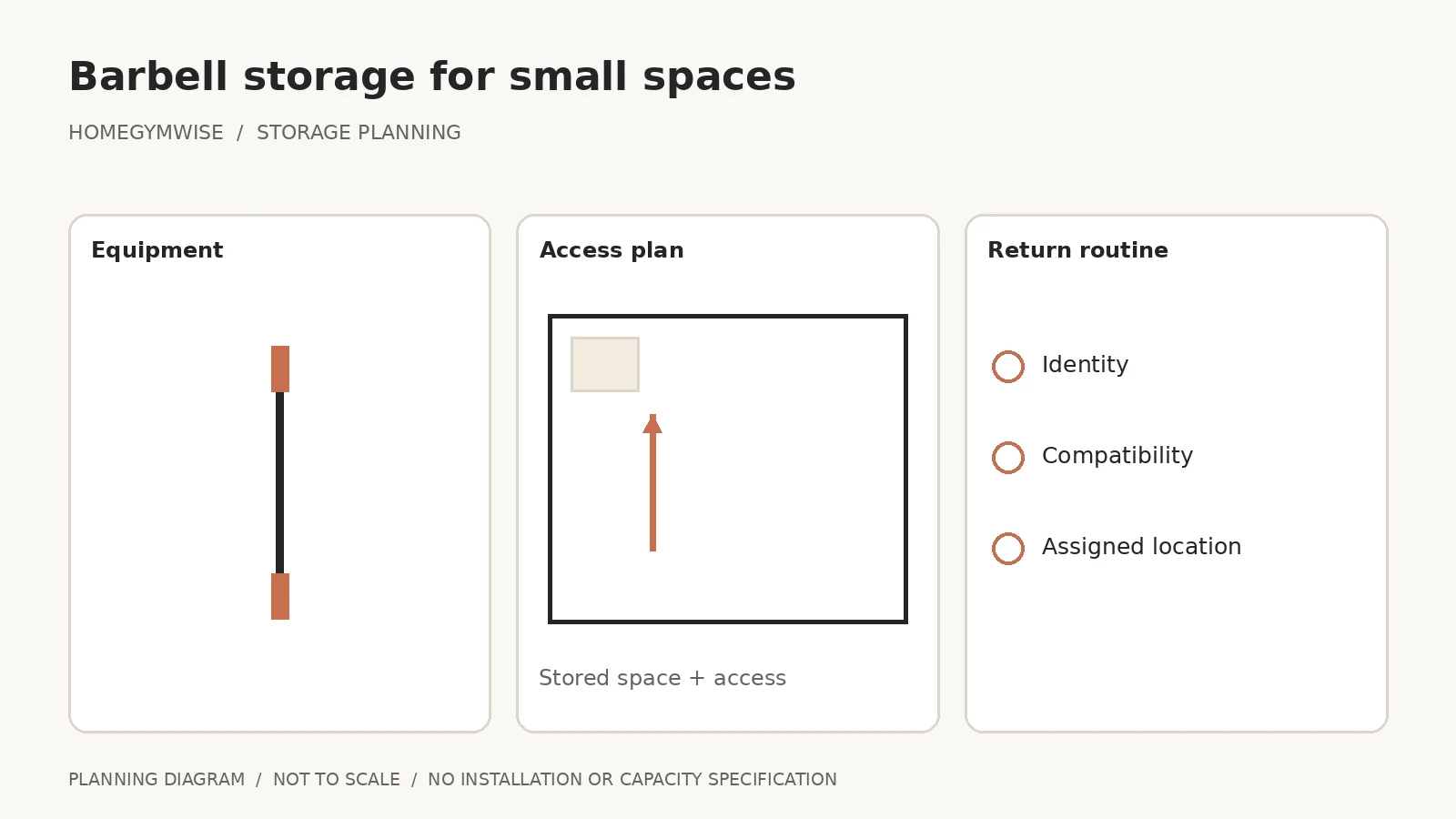
Choose vertical or horizontal storage by the retrieval path
Vertical barbell storage is worth considering when the holder fits your bar and you have room to lift the bar out, carry it into position and put it back. A narrow parked footprint is only part of that decision. If retrieval conflicts with the ceiling, a door or nearby furniture, compare a horizontal arrangement instead.
Plan around an unloaded bar and a holder intended for it. A bar leaning loosely against a wall is not the storage format assessed here. Wall hangers, rack attachments and freestanding holders also need different compatibility checks; none earns approval just because it looks compact.
The useful question is: can this arrangement accommodate both the bar at rest and the way you will actually retrieve it? Start there before deciding where the holder belongs.
Measure the bar and the space needed to remove it
Make a simple sketch using your own equipment rather than a standard ceiling-height rule.
- Record the bar’s overall length and the contact dimensions required by the candidate holder. Distinguish a sleeve-supported arrangement from one that contacts another part of the bar.
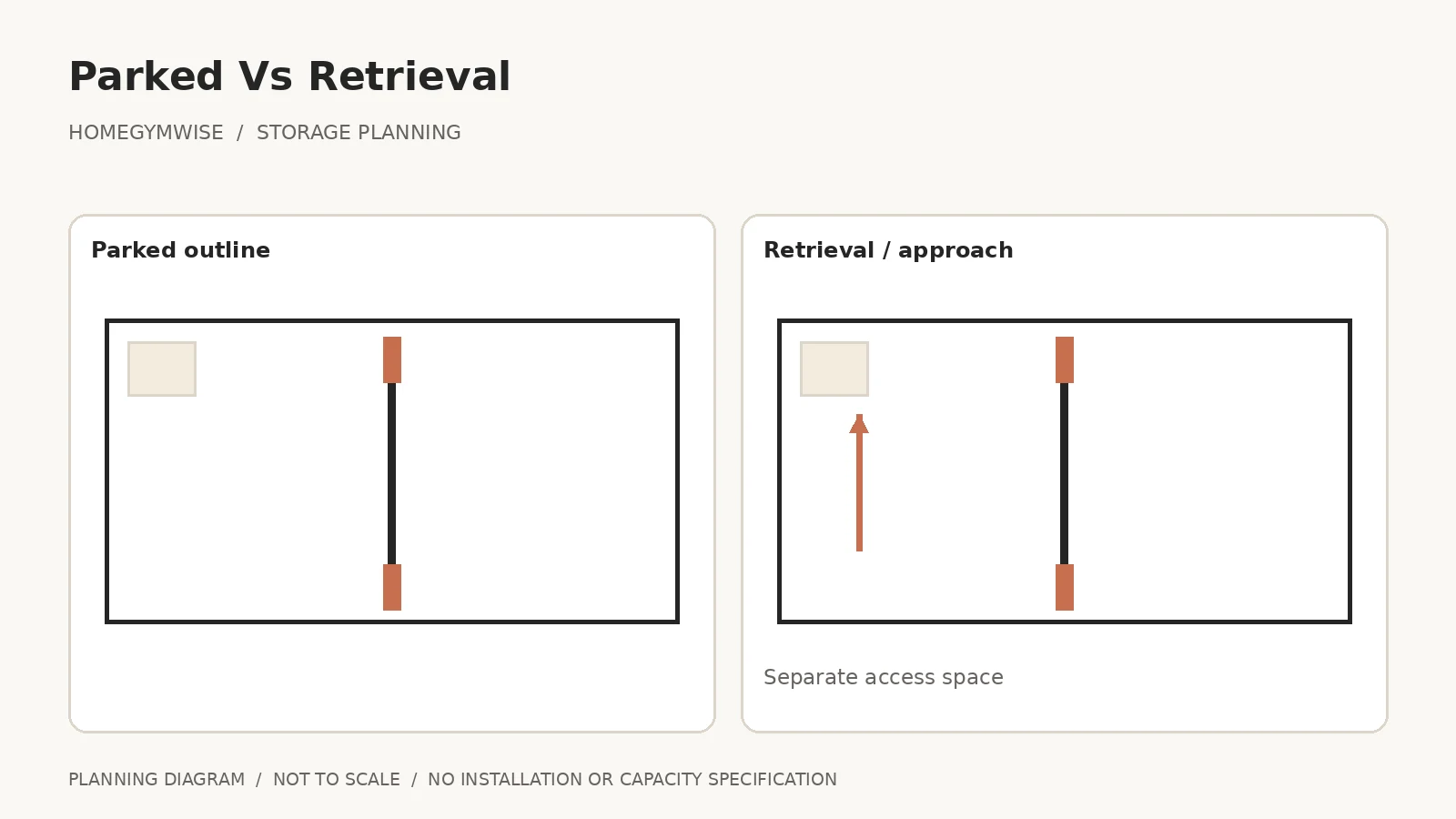
- Mark the holder’s actual base or wall outline and the bar’s parked position.
- Add the insertion and removal path described for that holder. A storage outline is not a movement clearance specification.
- Mark nearby door swings, shelves, lights and furniture. Include the place where you will stand and the route toward the lifting area.
For example, a corner can leave enough room for a parked bar while a shelf above it obstructs removal. Moving the holder farther into the room might resolve that obstruction but consume the walkway you were trying to recover. Compare both positions on the sketch; do not assume the smaller outline wins.
If you cannot identify the required insertion motion or compatible contact points, leave those entries unresolved before choosing the holder.
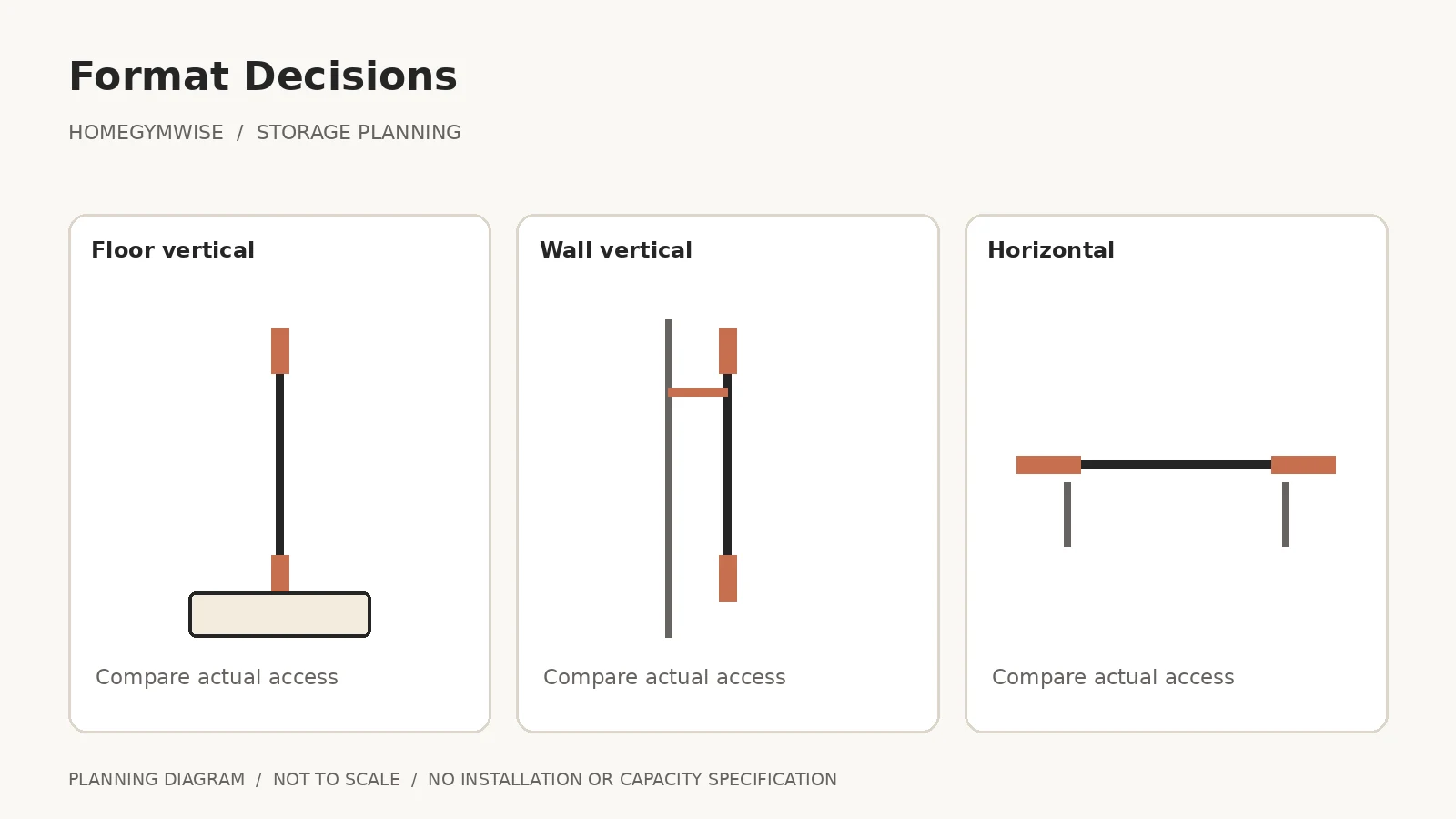
Compare storage formats by daily access
Compare the formats by their requirements, not by a generic claim that vertical storage is always best for small rooms.
| Format | What to check | When it changes the choice |
|---|---|---|
| Freestanding vertical holder | Actual base, compatible bar contact and removal envelope | Useful to compare when wall mounting is unavailable; the base still needs a suitable location |
| Wall-mounted vertical hanger | Permission, documented mounting prerequisites and upward access | A clear floor does not compensate for an unresolved wall installation |
| Rack attachment | Exact rack/attachment compatibility and interference with training | Compare it when the existing rack can accept the intended attachment without obstructing its use |
| Horizontal storage | Wall or floor span, approach and removal path | Worth considering when overhead retrieval is the limiting factor |
These are planning alternatives, not interchangeable products. A holder that accommodates one bar is not automatically suitable for a different sleeve, specialty-bar shape or additional equipment. Write down which compatibility question remains open for each candidate.
Remove a format from the shortlist if its required access cannot fit the room; do not compensate by inventing a different insertion technique.
Resolve mounting and holder compatibility before installation
For a mounted option, separate three questions: are you permitted to install it, what substrate/support does the system require, and what exact equipment is it intended to hold? Permission alone answers only the first.
A representative Rogue wall-system manual illustrates why this distinction matters: it treats support for the unit and stored gear as an installation requirement. That is an example from its own bracket system, not instructions for installing a barbell hanger.
Before installation, resolve the actual holder’s approved bar contact, load and mounting requirements with its documentation and, where needed, a qualified installer. This guide supplies no anchor substitutions, structural calculations or drilling pattern. An undocumented wall or attachment is a reason to pause that option, not to improvise a load test.
If mounting remains unresolved, keep a documented freestanding alternative on the shortlist and assess its own support and access requirements.

Make putting the bar away part of the room plan
Choose one return location that remains accessible after the workout, including when other household items are back in place. A storage plan that works only with a door shut or furniture moved may be too inconvenient for daily use.
Record four things beside your sketch: the chosen holder, the bar it is intended for, its retrieval path and the condition checks required for that system. Follow those checks before use; visible damage or an unresolved attachment problem needs attention rather than another bar added to the same location.
Keep the approach available and reassess the plan when the equipment changes. Spare visual space is not evidence of extra holder capacity. For the broader arrangement of bands, weights and other equipment, use the home gym storage ideas overview.
Your next step is a short shortlist with measured access and documented compatibility, not a purchase based solely on how little floor space the holder appears to occupy.