A Renter-Friendly No-Drill Home Gym Starts With Permission and Removal

A renter-friendly home gym needs both property permission and a removable setup that is compatible with the room. ‘No-drill’ describes an attachment choice; it does not prove that equipment is permitted, that a floor finish will be unaffected or that a product meets its installation requirements.
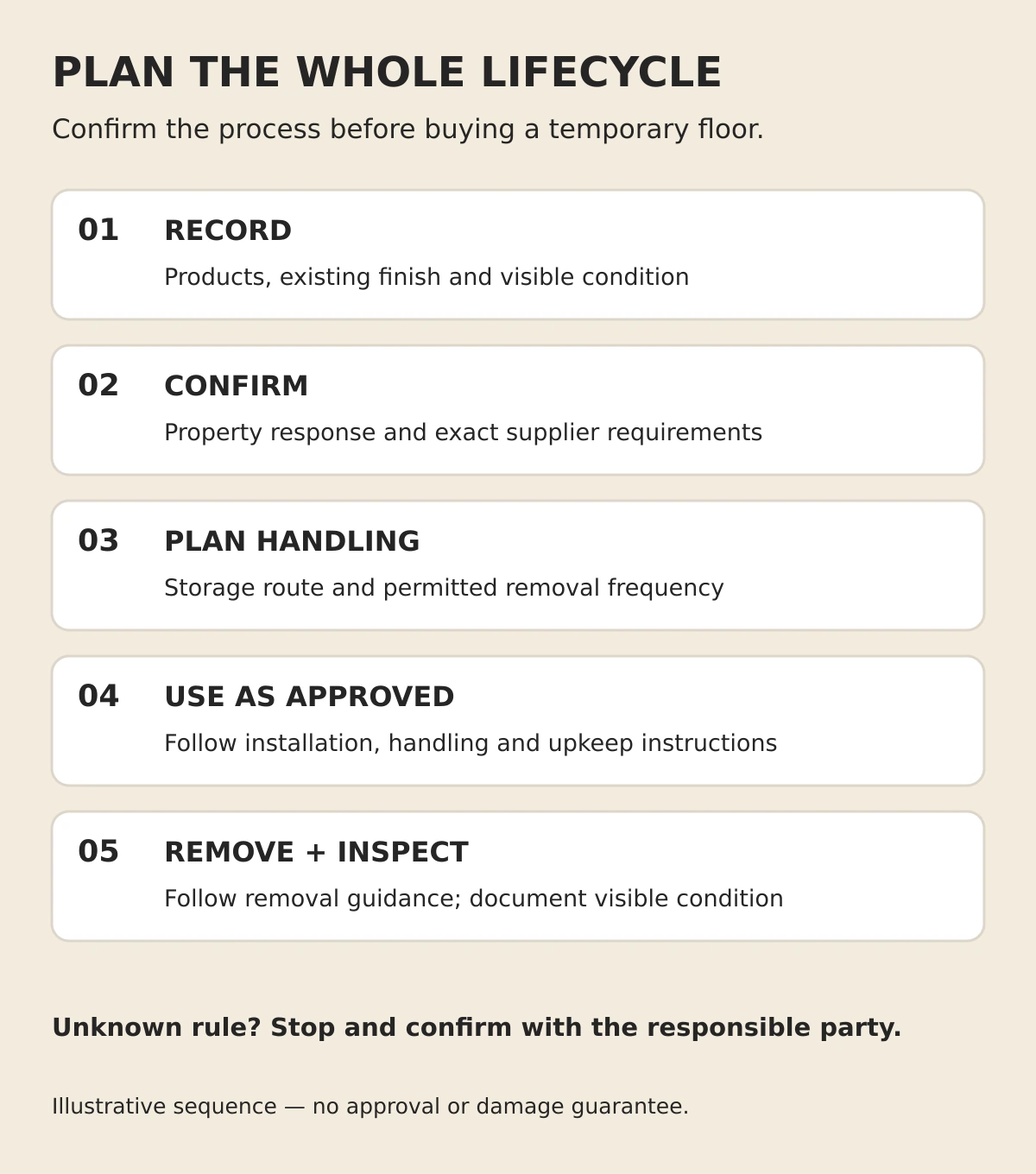
Start with what you will install, what it touches and how you will remove it. This guide focuses on reversible planning and temporary flooring, rather than approving wall-mounted or doorway-supported equipment.
Define what your rental agreement allows
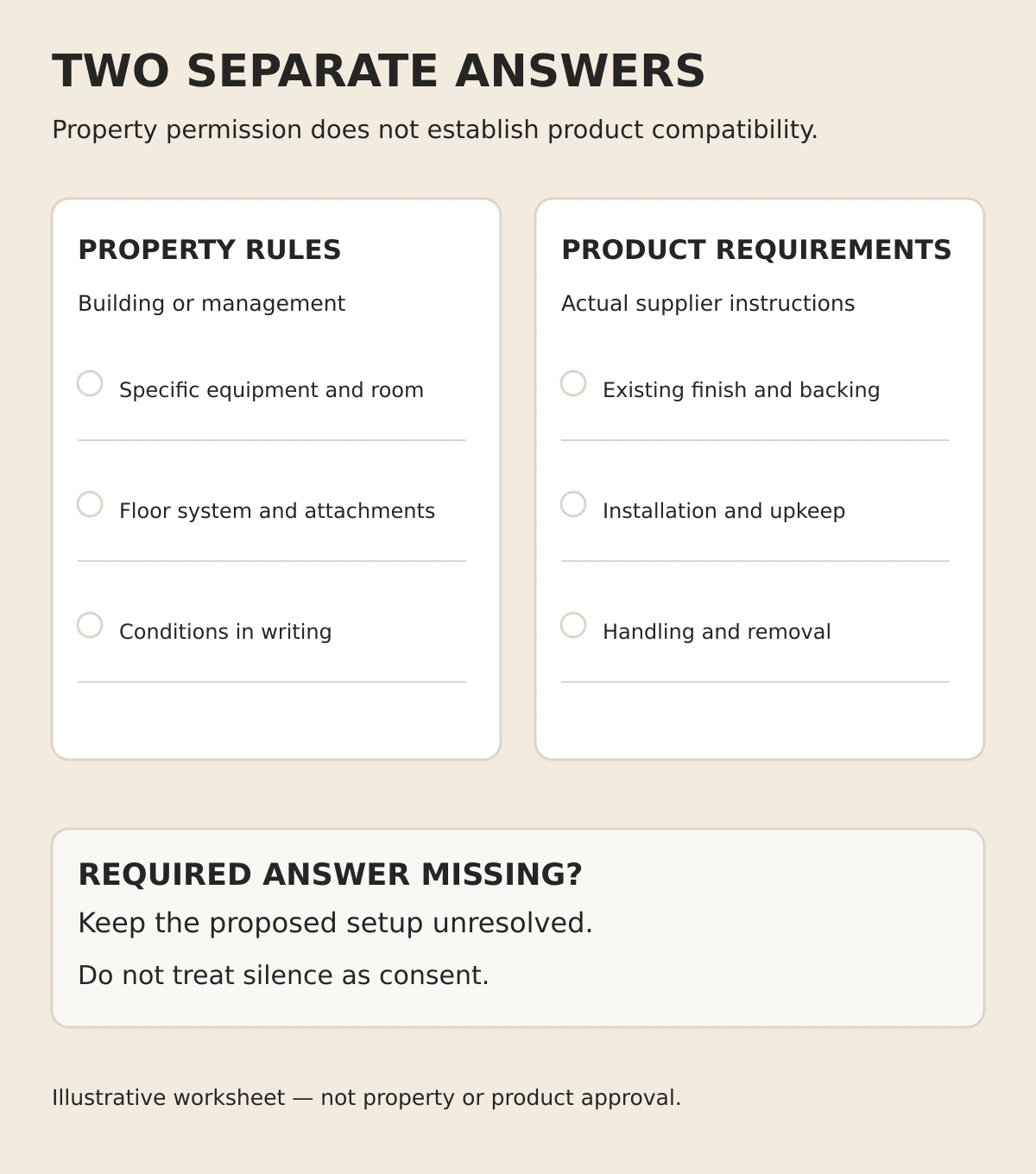
Review the rental agreement and ask management about the specific proposed setup where permission is unclear. Describe the equipment, location, floor system and any proposed attachment or adhesive. A broad request for ‘a few mats’ may omit the part that matters.
Keep property approval separate from manufacturer approval. Management can address the property’s rules; a product supplier addresses the product’s requirements. Neither answer automatically supplies the other. If a building-specific issue remains unresolved, identify who is authorized to answer it rather than treating silence as consent.
Retain the written response with the plan you submitted.
Check what removable really means
Ask how the product is installed, maintained, lifted and removed. Identify every contact material: the gym surface, backing, proposed tape or adhesive, and anything added between it and the existing finish. Record unknown materials as unknown.
Do not assume ‘temporary,’ ‘rental-friendly’ or ‘no-drill’ means a guarantee against marks or damage. Request the applicable compatibility and removal instructions for the actual finish. A small trial, if a supplier suggests one, still does not establish every long-term condition; follow the supplier’s stated scope.
Avoid adding wall or doorway supports to this approval by implication. Those products need their own exact requirements and permissions.
Approve the temporary floor system
For flooring, identify the complete system rather than the visible top layer alone. Ask whether the supplier permits the proposed base and intended equipment use.
Greatmats’ surface guidance, for instance, cautions against its rubber mats and rolls directly on carpet. A removable product can still have substrate restrictions.
If carpet is involved, resolve that compatibility question before deciding how the floor will look. If moisture is unresolved, address the cause rather than covering the area; EPA’s guidance explains the importance of moisture control. Do not improvise a layered floor to work around a supplier restriction.
Plan storage and removal before buying
A reversible installation should also fit your routine. Decide whether it stays in place, is removed after exercise or is removed only when you move out. Confirm that the selected product allows the planned handling and repeated assembly.
Measure the storage location and access route against the actual product information. Keep the room’s doors and normal circulation in the plan. Do not assume a surface that fits when laid out will be convenient to store.
Ask what removal and inspection should involve and who is responsible for any unresolved restoration work. Make that decision before buying, while changing the plan is still straightforward.
Keep a simple permission record
Use this request as a starting point:
‘I propose [equipment] in [room], using [exact temporary floor system] over [known existing finish]. The installation uses [method, including any attachment materials]. I intend to remove it [frequency/end date] following [supplier instructions]. Please confirm property permission and identify any conditions or further information required.’
Keep an inventory of the proposed products, supplier approvals, property response and dated photos of visible pre-existing conditions. Photos document what was visible; they do not certify hidden conditions.
If a required answer is missing, keep the setup unresolved. A different permitted location or simpler approved arrangement may be the better choice. The useful outcome is a plan you can install and remove under known conditions.