How to Reduce Treadmill Noise in an Apartment
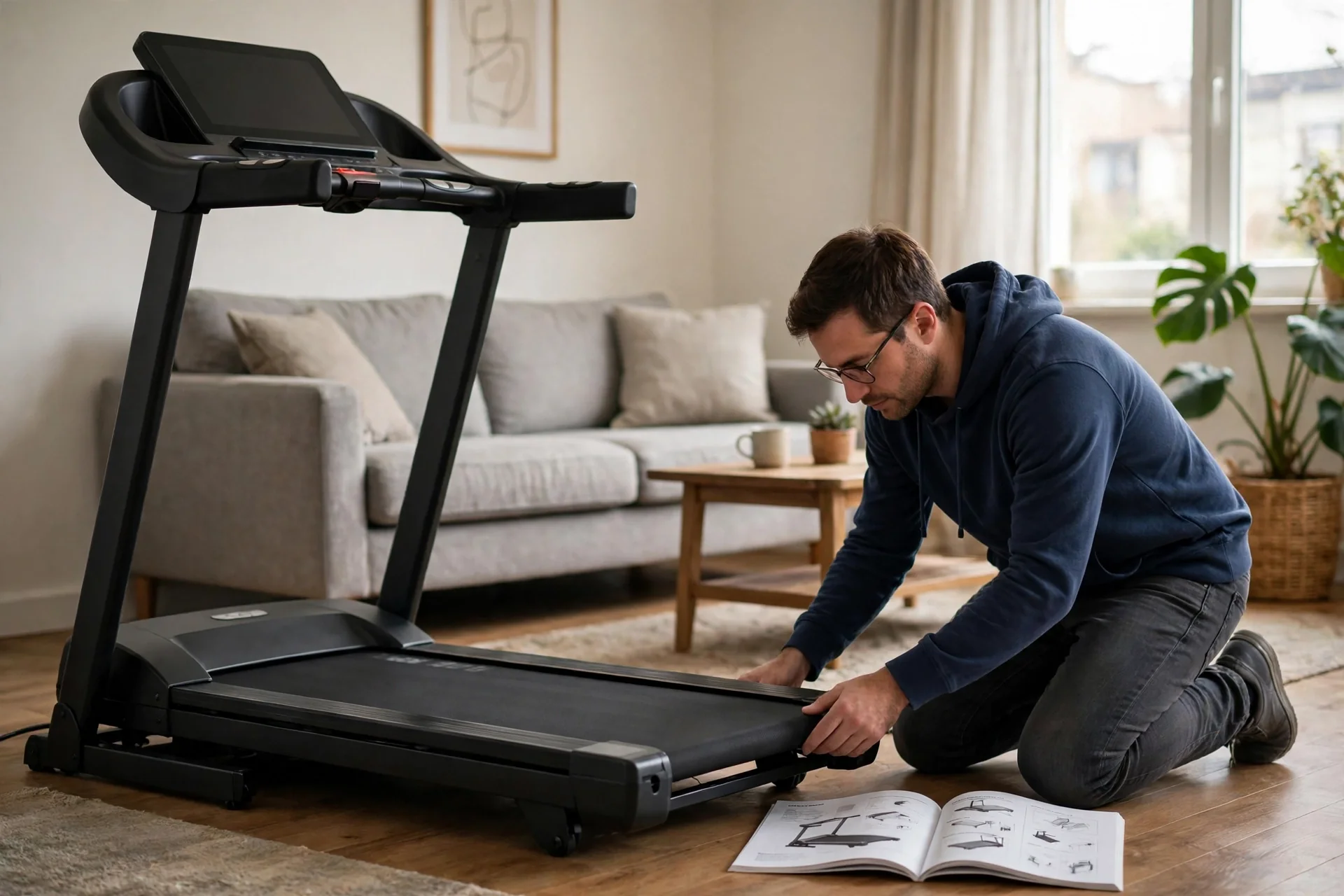
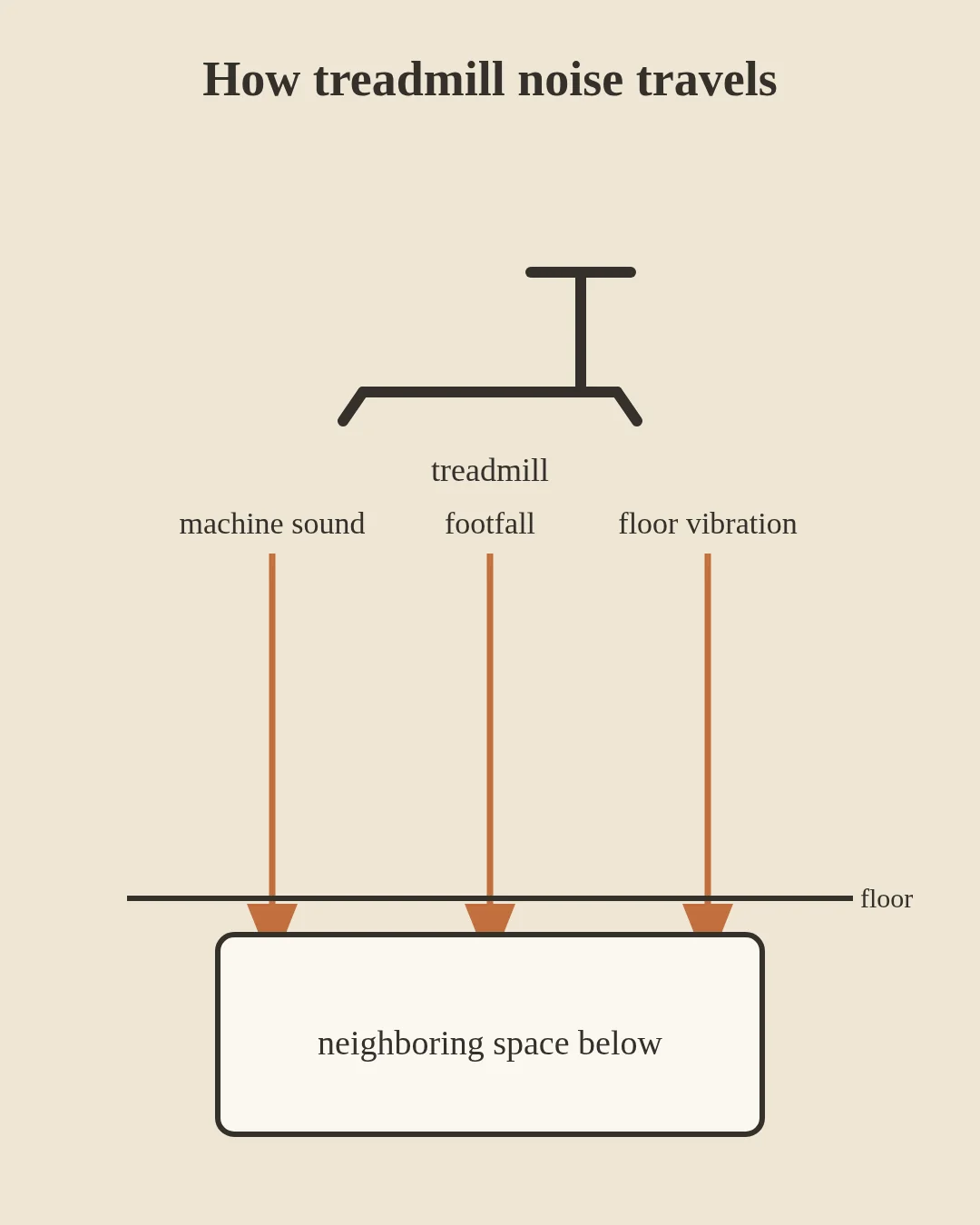
To reduce treadmill noise in an apartment, first identify whether you hear the machine, your footsteps, or vibration traveling through the floor. Then check the treadmill’s condition and placement before adding a mat. Reassess the disturbance after each permitted change, including what a downstairs neighbor hears when that is the problem.
A quieter room does not prove a quieter apartment below. The goal is to reduce avoidable noise and find out whether your treadmill can be used without an unresolved disturbance. Silence is not a promised outcome.
Before inspecting anything, stop the belt and follow your model’s shutdown and unplugging instructions. Keep hands and objects away from moving parts. If the treadmill grinds, scrapes, feels unstable, or shows damage, skip further operating comparisons and contact the manufacturer.
Identify Where the Treadmill Noise Comes From
Write down when the sound occurs: with each footstep, repeatedly as the belt moves, only during incline changes, or alongside visible frame movement. Describe the sound rather than naming a failed part. A thump is a clue, not a diagnosis.
Motor, Belt, and Roller Sounds
The running belt, rollers, and motor can contribute to the sound you hear while the treadmill operates. Horizon Fitness describes belt-over-roller thumping as one possible operating sound, especially on new treadmills. That does not establish that every new thump is harmless. See its treadmill noise guidance. [S01]
If your manual provides a safe procedure for observing belt operation without a user, follow that procedure to distinguish a repeating machine sound from footsteps. Otherwise, ask support how to make the distinction. Do not invent an unattended running test, reach beneath a moving belt, or remove a cover to locate a sound.
Footstep and Deck Impact
A sound that follows each landing suggests footfall or deck impact may contribute. Note whether it changes during your ordinary walking and running use, without deliberately stomping or increasing speed to provoke it.
For example, if the repeated disturbance appears during running but not during a comfortable walk, record that difference. It helps narrow the next conversation with support or building management; it does not certify walking as acceptable downstairs.
Floor Vibration and Nearby Rattling
Airborne sound travels through air. Structure-borne vibration travels through connected building elements and can create sound elsewhere. CDC/NIOSH illustrates machinery vibration reaching another room through a floor; its guidance concerns workplaces, not tested apartment treadmill setups. [S03]
Also check for nearby objects that rattle or touch the frame. A loose item on adjacent furniture can complicate the picture. Remove accessible loose objects only while the machine is stopped and safe to approach. Never touch or brace a moving treadmill to diagnose vibration.
Check Your Treadmill Before Changing the Floor Setup
Find the manual for the exact model and revision. Have its model and serial number available if you need support. Use its instructions for assembly checks, leveling, belt care, and owner-permitted maintenance.
Check Leveling and Loose External Parts
With the treadmill shut down as instructed, check whether all intended support points rest on the approved surface. Look for accessible loose assembly hardware, objects beneath the machine, and unintended contact with furniture. Follow the manual for any adjustment or tightening; do not guess at torque or alter parts that are not owner-serviceable.
Sunny Health and Fitness’s external squeak and creak guidance identifies supporting-surface stability and leveling as checks for its equipment. Use that as a reason to review your own model’s setup instructions, not as permission to apply Sunny’s repair procedures to another machine. [S02]
Review Belt Alignment and Maintenance
Review the manual’s requirements for belt alignment, tension, cleaning, and lubrication. Requirements depend on the model. Do not add lubricant simply because the treadmill squeaks, and do not assume every running belt needs periodic owner lubrication.
If the belt appears off-center or worn, ask whether the manufacturer permits an owner adjustment and which procedure applies. Avoid trial-and-error tension changes or lubricant substitutions. A noise description alone cannot tell you the correct maintenance action.
Know When to Stop and Request Service
Stop use and request manufacturer guidance for grinding, scraping, visible damage, abnormal deck movement, or unresolved instability. A sudden change in the usual operating sound also deserves investigation before you try to hide it with padding. These are conservative escalation triggers, not remote fault diagnoses.
Send support the model, the conditions in which the sound occurs, and any existing recording you can obtain safely. Do not reproduce a concerning fault just to capture a better video. Leave motor covers, electrical components, and internal repairs to authorized service.
Improve Treadmill Placement in Your Apartment
Review these constraints before moving the treadmill:
| Check | What you need to establish |
|---|---|
| Building permission | Whether the lease and building rules allow the equipment, location, and intended use |
| Supporting surface | Whether the model permits the floor covering and can sit level and stable on it |
| Operating space | Whether the exact manual’s clearances, ventilation, and access requirements remain available |
| Floor suitability | Whether building documentation or a qualified professional is needed to resolve uncertainty |
| Moving and power instructions | Whether relocation and the new power connection follow the manufacturer’s requirements |
A wood floor surface alone does not reveal the construction or suitability of the floor beneath it. Do not infer structural capacity from a machine feeling stable, and do not select a supposedly stronger location based on a generic rule about walls or corners.
Room acoustics matter too. Horizon notes that nearby walls and different floor surfaces can change perceived sound. [S01] If another permitted location meets the manual’s requirements, it may be worth reassessing there. Moving the treadmill does not guarantee less transmission downstairs.
For someone still planning a first setup, resolve permission, model requirements, and floor questions before treating noise accessories as the solution. A mat cannot establish that an apartment is suitable for treadmill use.
Can a Treadmill Mat Reduce Noise?
A compatible treadmill mat may help with some floor-transmitted vibration or reverberation. Its effect depends on the machine, supporting floor, material, and operating conditions. It cannot be assumed to repair a mechanical fault or eliminate footfall disturbance. [S01, S03]
What to Check Before Using a Mat
Ask the treadmill manufacturer whether the proposed mat is suitable for your exact model and floor covering. Check the mat maker’s compatibility information as well.
| Question | Why it matters |
|---|---|
| Is this treadmill-and-floor combination permitted? | A general equipment-mat label does not resolve model restrictions. |
| Does the mat support the intended contact area? | The machine must retain its required support and stability. |
| What happens under the machine’s support points? | Compression or uneven support needs manufacturer assessment. |
| Are folding, ventilation, and clearances preserved? | Adding material must not interfere with required operation. |
| Is a noise claim backed by relevant testing? | Floor protection and acoustic isolation are different claims. |
No comparable apartment testing is supplied here to justify a mat ranking, fixed noise reduction, or universal thickness. If the seller provides only a broad “anti-vibration” claim, ask for the test conditions and limitations rather than assuming a result in your building.
Why Extra Padding Is Not Always Better
Do not stack foam tiles, loose pads, or improvised platforms under a treadmill to chase a quieter sound. Additional cushioning can compromise the stable support the machine needs. CDC/NIOSH warns that incorrectly selected machinery isolation can increase vibration; that principle is a reason to seek appropriate guidance, not a treadmill-mat specification. [S03]
If an approved mat leaves the machine rocking, shifting, or unevenly supported, stop using that arrangement and consult the manufacturer. Do not compensate with wedges or another layer.
Adjust How and When You Use the Treadmill
Once the machine and setup are suitable, compare only ordinary, comfortable operating modes allowed by the model. Walking instead of running, or a comfortable slower pace, may change the disturbance. Neither guarantees quiet enough use for a neighboring apartment.
Keep your natural gait. Do not tiptoe, force an unfamiliar foot strike, or hold yourself differently just to suppress sound. If comfortable use still causes a disturbance, the setup needs reassessment.
Check actual quiet hours and any separate equipment restrictions. Being outside quiet hours is not automatic permission to create ongoing disturbance. Where practical, agree on a permitted time for a short comparison with the affected neighbor.
Change one factor at a time and keep a simple log:
| Date and time | Permitted change | What you heard | Neighbor feedback, if available | Decision |
|---|---|---|---|---|
| Example only | Comfortable walking in place of usual running | Describe sound; do not invent a measurement | Record feedback or “not checked” | Keep, reassess, or stop this use |
What If Your Downstairs Neighbor Still Hears It?
Ask when the disturbance happens and whether they hear a hum, repeated impacts, or rattling. Compare that timing with your use log. Do not assume your motor is faulty—or that the complaint is resolved—based only on what you hear upstairs.
If both parties and building rules permit, agree on one short comparison after a safe, approved change. Persistent downstairs impact despite a quieter treadmill room is a reason to review transmission through the building, rather than buying more padding without guidance.
Contact the manufacturer for machine and accessory questions. Contact building management for permitted locations, use restrictions, and unresolved floor concerns. A qualified building or acoustic professional may be needed when those questions cannot be answered from the available documentation.
A phone recording can help describe the timing or character of a sound. A consumer phone decibel reading does not certify neighboring-unit compliance or prove a floor-transmission problem is solved.
If permitted adjustments do not resolve the disturbance, pause the problematic use while the next step is agreed. Some apartment-and-treadmill combinations may not support the intended activity without unacceptable disturbance.
Treadmill Noise Troubleshooting Checklist
Use this sequence: identify the pattern, inspect within the manual’s limits, make a permitted change, reassess, and escalate if unresolved. The possibilities below are not confirmed fault identifications.
| Symptom | Possible contributor | Safe next step | Escalation point |
|---|---|---|---|
| Repeated thumping | Belt/roller interaction or footfall | Note whether it follows steps; distinguish operation without footsteps only through a manufacturer-permitted procedure | New, changing, or unexplained thumping needs support review |
| Squeaking | Mechanical contact or wear | Review the exact model’s maintenance guidance | Do not guess at lubricant or an internal repair |
| Rattling | Accessible hardware, nearby objects, or unintended contact | Shut down as instructed, then inspect accessible areas | Request service if the source remains unclear |
| Strong vibration | Instability, floor contact, or operating impact | Stop and review approved placement and leveling | Do not continue with unresolved instability or floor concerns |
| Grinding or scraping | Possible mechanical fault | Stop use | Consult manufacturer support before resuming |
| Noise mainly heard downstairs | Possible structure-borne transmission | Review permitted isolation, operating mode, and building constraints | Escalate persistent disturbance to management and appropriate specialists |
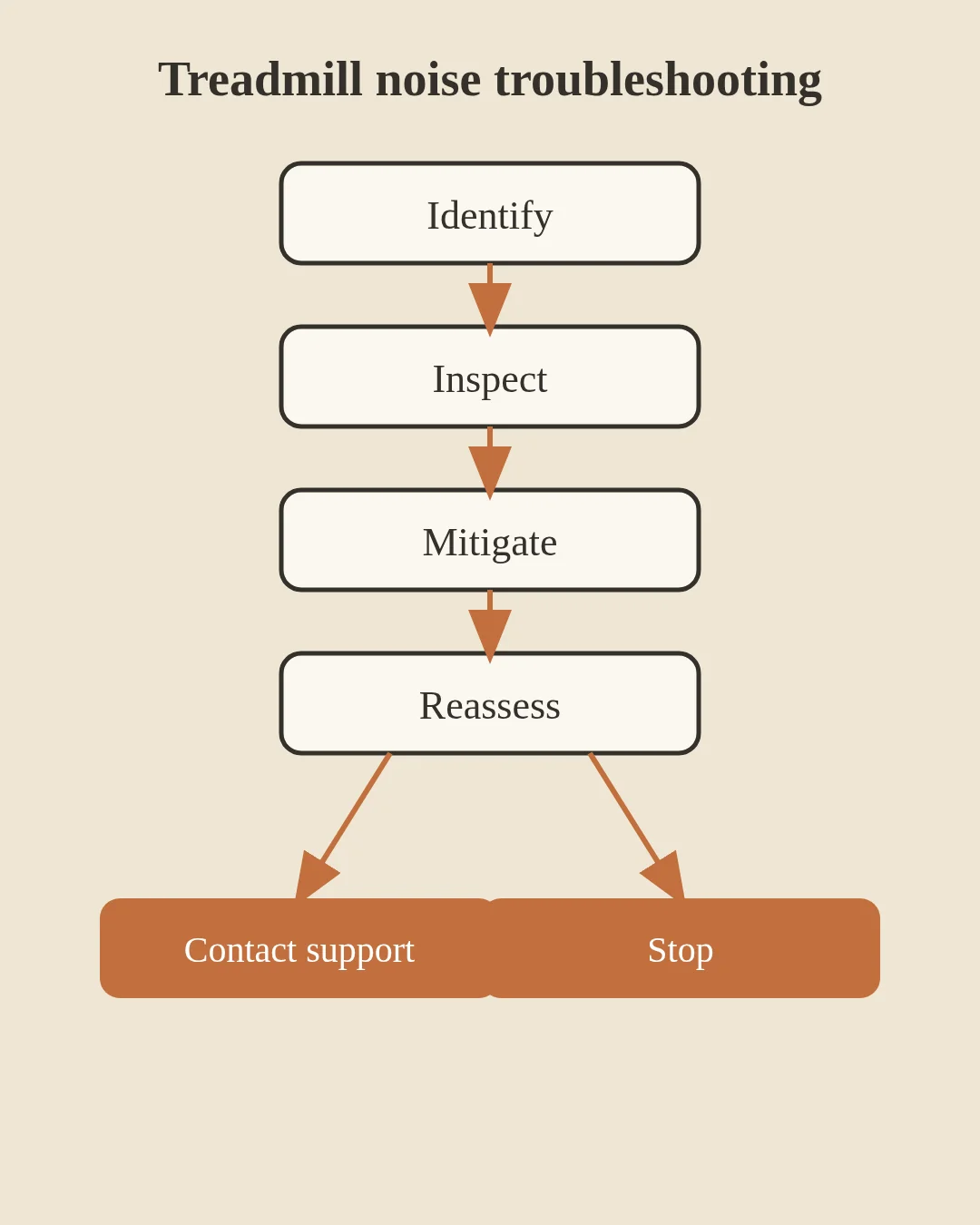
Before the next session, confirm that there is no unresolved stop-use concern, the setup follows model and building requirements, and any earlier neighbor disturbance has been reassessed. If one of those questions remains open, resolve it before continuing the problematic use.
Frequently Asked Questions
Is a walking pad necessarily quieter than a running treadmill?
No. The equipment category alone does not establish the noise experienced in another apartment. Model condition, the user’s activity, placement, and the building all matter. No comparable measurements are supplied here to rank the two formats.
Can I use a treadmill on carpet to make it quieter?
Only if the exact model’s instructions permit that carpet-and-support arrangement. A carpeted room sounding quieter does not establish stable support, adequate ventilation, or less disturbance downstairs. Check with the manufacturer before adding a mat over carpet.
Can I compare treadmill noise ratings from different brands?
Only when the measurement conditions are comparable. Check operating speed, whether a user was present, microphone position, supporting surface, and test method. A rating without those details cannot predict your neighbor’s experience.
What if I cannot find the manual?
Use the model and serial number to request the correct manual from the manufacturer. Ask specifically about the observed noise, permitted placement, mat compatibility, and owner maintenance. Defer adjustments whose correct procedure is unknown.