Under-Desk Bike vs Elliptical: Check Desk and Chair Fit
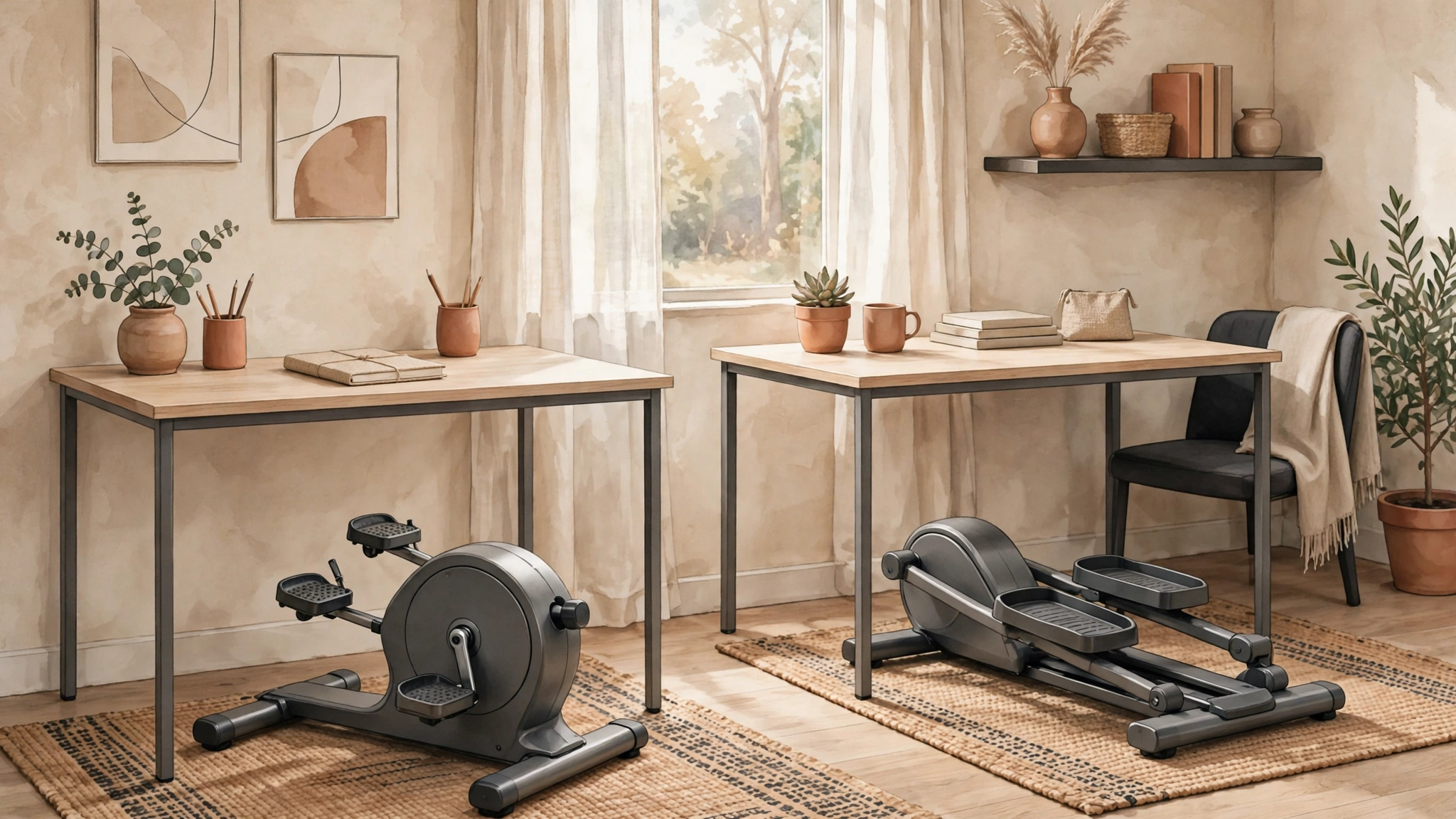
An under-desk bike and an under-desk elliptical can both look compact in product photos. The choice becomes clearer when you stop comparing labels and test the working geometry: how high your knees rise, how far your feet travel, whether the chair stays put, and where the machine goes when you are finished.
Neither format is the automatic winner. Choose the one whose exact model fits your desk, chair, body position and daily routine.
Start with a seated fit test
Measure the setup you actually use, not an empty desk.
- Set the chair to your normal working height and sit in your usual posture.
- Measure from the floor to the underside of the desk at the point directly above your knees. Watch for a drawer, support rail or keyboard tray that hangs lower than the desktop.
- Measure the top of your knees in that seated position.
- Subtract knee height from the lowest underside measurement. That is your static clearance before a pedal starts to lift your leg.
- For any shortlisted machine, reproduce a full slow cycle and confirm clearance at the highest knee position, not only when the pedals are level.
Cubii’s support guidance recommends at least 2 to 3 inches between the desk underside and the user’s knees for comfortable use. Treat that as useful screening guidance, not a guarantee that every Cubii model, desk or body position will fit.
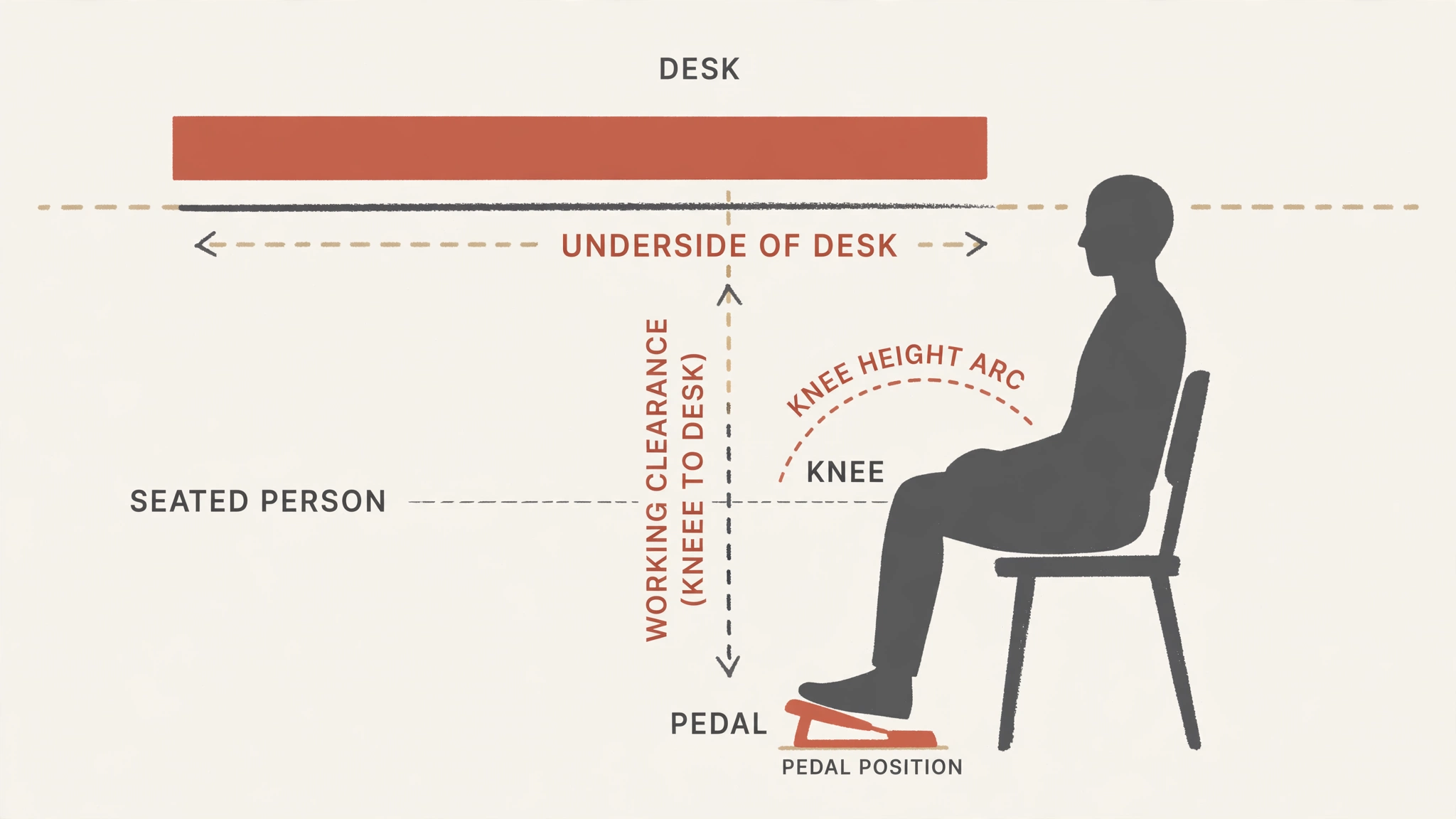
If you cannot verify the working clearance, defer the purchase. A return policy is a poor substitute for measuring first.
How bike and elliptical motion change fit
A pedal bike turns each pedal around a crank, so the foot follows a circular path. The highest point of that circle raises the knee. An under-desk elliptical guides the foot through an oval path, but its height, length and angle vary by model.
That difference can make an elliptical feel flatter in some setups, yet “elliptical” does not prove that your knees will clear the desk. A tall pedal deck, a forward chair position or a low support rail can erase the apparent advantage. The same caution applies to a bike: a low listed pedal height helps screening, but the rider’s leg length, chair height and distance from the machine still determine actual knee rise.
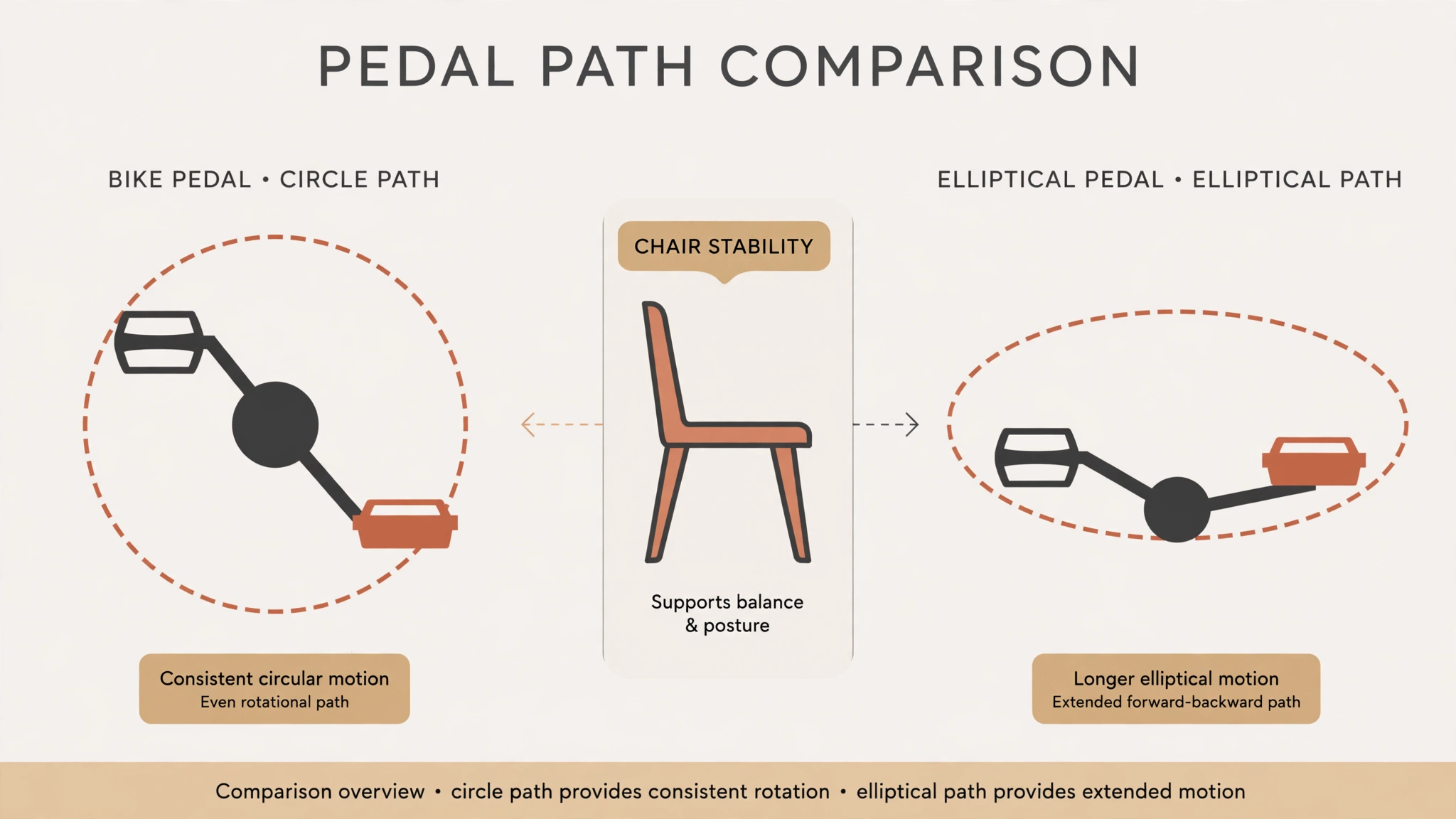
Use motion preference as a second-stage choice. First prove that both the highest knee position and the forward reach are comfortable without leaning, perching on the chair edge or pulling the machine toward you.
Compare exact-model space requirements
The current DeskCycle 2 listing gives a useful bike-format example. VIVO lists it at 10.2 inches deep by 24 inches wide by 20.1 inches high, with the maximum pedal height adjustable to 9 or 10 inches. Those are exact-model specifications, not category averages.
The 9-inch setting may create more desk clearance than the 10-inch setting, but it still does not tell you the height of your knee at the top of the cycle. Combine the specification with the seated test. Also mark the 24-inch width and the machine’s forward position on the floor, then check whether your chair base can sit close enough without touching the unit.
For an elliptical, collect the same exact-model inputs: overall width and length, pedal-deck height, the shape of the pedal path, recommended chair position and any clearance guidance in the manual. If a seller supplies only a generic “low profile” description, the evidence is incomplete.
Use the small home gym floor-plan guide to check the machine, chair and traffic path together after you have exact measurements.
Check chair stability and daily handling
The floor plan can work on paper while the chair still rolls away during use. Test the complete chair and floor combination. A rolling office chair on a smooth hard floor behaves differently from a fixed chair or the same chair on carpet. Do not improvise a wheel restraint that conflicts with either product’s instructions; instead, resolve stability with the exact manuals and a setup that remains secure during a full slow cycle.
Then check reach. If the machine has to sit too far forward to clear the chair base, you may start reaching with your toes or leaning away from the backrest. If it sits too close, your heels, pedals or knees may contact the chair or desk.
Finally, rehearse the storage routine. Ask where the unit will live, whether you can move it without striking furniture, and whether repositioning it under the desk every day is realistic. A slightly larger machine that stays aligned may be more practical than a smaller one you have to drag into place for every session.
Use a choose-bike, choose-elliptical or defer rule
Choose a bike format when the exact circular pedal path clears the desk, the chair can sit at a comfortable distance, and you prefer that pedaling motion. Confirm the exact model’s dimensions and pedal-height setting rather than borrowing the DeskCycle 2 measurements for another bike.
Choose an elliptical format when the exact model’s oval path fits your knee-clearance and reach test, the chair remains stable, and you prefer the flatter-feeling motion and handling routine. Do not assume every elliptical has the same trajectory.
Defer both when any of these remain unresolved:
- your knees approach the desk underside at the highest point of the motion;
- a drawer or support rail reduces clearance;
- the chair rolls, swivels or forces an awkward reach;
- exact-model dimensions or instructions are missing;
- the unit has no realistic daily storage position.
The useful comparison is not bike versus elliptical in the abstract. It is exact bike versus exact elliptical in your measured desk-and-chair setup. When both pass, motion preference and handling can decide. When only one passes, geometry has already made the choice.