Compact Folding Treadmills: Check Both Room States Before Buying
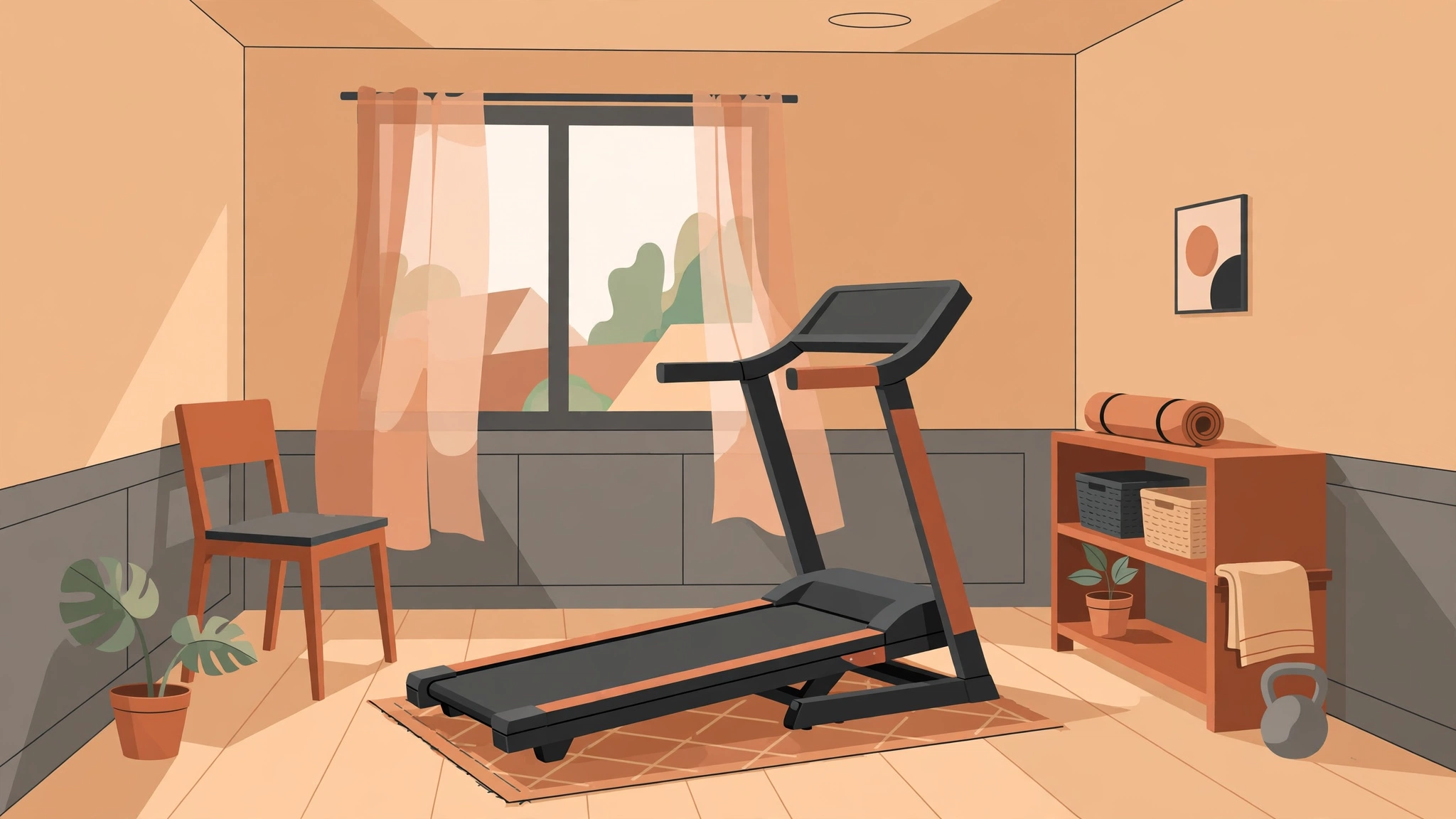
A compact folding treadmill needs to fit your room twice: once while you use it and again when the deck is folded. Check the open exercise setup first. A useful folded position cannot compensate for an unsuitable working area.
Keep three measurements separate throughout the comparison: the running surface, the complete machine and the room space required for use. They answer different questions. A small advertised footprint or a folding photograph does not settle all three.
Choose the treadmill by its open setup first
Start with the activity the machine must support, then check the exact model’s intended use and specifications. Avoid choosing solely by the smallest folded size and discovering afterward that the equipment does not suit the activity you wanted.
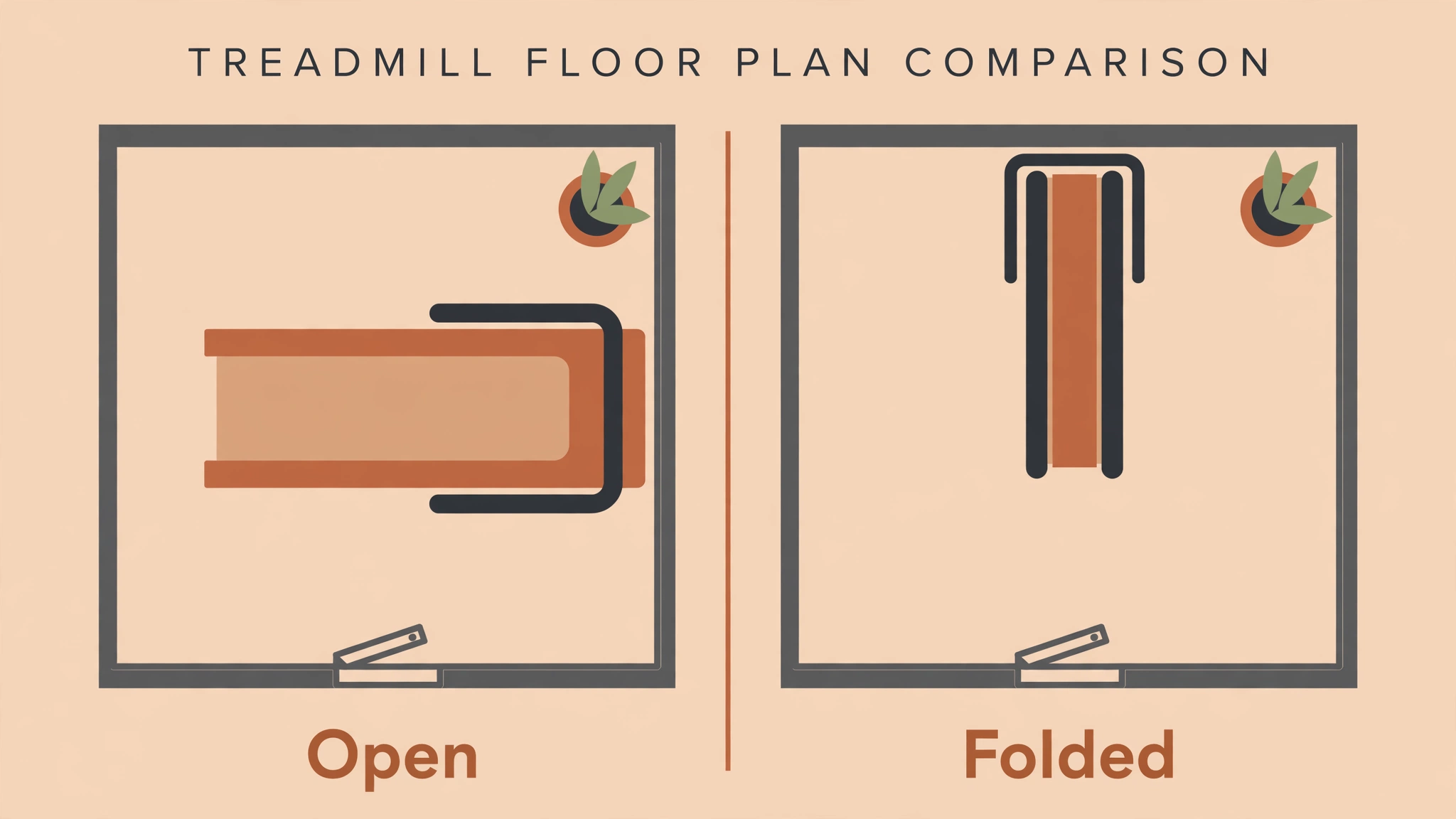
Draw the complete machine in its proposed operating position. Apply the manufacturer’s required clearances and consider getting on and off, reaching the controls and moving through the rest of the room. Keep doors and furniture in their normal positions on the drawing.
The running belt’s dimensions do not describe the outside of the treadmill. Equally, the outside dimensions do not include every use requirement. Do not substitute a generic clearance figure for the selected manual.
If the only workable position blocks the room’s normal access, consider a different candidate or layout before investing time in its folding features.
Read folded dimensions as a different room shape
Folding often changes the shape of a treadmill into a standing storage block. Read the folded length, width and height together. Do not assume a folded treadmill will fit beneath furniture or leave the floor almost empty.
Mark the stored position separately from the operating position. Then check the movement between them: where the deck travels while lowering, where you need to stand and whether anything must be moved first. Use the exact handling instructions for that model.
A machine that stays in one position may need a simpler daily routine than one moved across the room. Conversely, retaining a folded machine beside a desk may consume the very access space you intended to recover. Decide which inconvenience the room can actually accommodate.
Compare the named Horizon table entries carefully
Horizon provides a useful dimensional example in the comparison table on its official T101 product page. The columns below are explicitly labeled T101 Connect and T202. Do not transfer the figures to another T101 generation or assume that a similar retail title identifies the same version.
| Official table entry | Assembled length × width × height | Folded length × width × height |
|---|---|---|
| T101 Connect | 70.5 × 33.5 × 59 inches | 46 × 34 × 61 inches |
| T202 | 76 × 34 × 57 inches | 48 × 34 × 62 inches |
These entries show why a single “compact” label is inadequate. The folded states are shorter, but remain substantial standing shapes. They also show why you should copy the full set of dimensions rather than retaining only the machine’s shortest measurement.
Investigate the T101 Connect table entry if that exact version’s use requirements and both room states work for you. Investigate the T202 entry if its larger listed arrangement fits and its documented features serve your needs. This comparison does not establish which runs better, sounds quieter or offers better value.
Before ordering, match the seller’s model identifier to the manufacturer’s current specifications and manual. If the product page, comparison table and supplied model documents differ materially, resolve that difference with the supplier.
Check delivery, power and the folding routine
The room plan is incomplete until the treadmill can reach its intended location. Compare the delivery package and any assembly requirements with doors, stairs and turns. The assembled dimensions are not a substitute for the shipping dimensions or the delivery team’s access requirements.
Clarify what the delivery service actually includes. Do not plan around carrying a large package upstairs or moving an assembled machine through a narrow turn without establishing how that task will be handled.
Next check the exact electrical instructions at the proposed operating position. The location of a convenient socket alone does not establish compliance. If the requirements are unclear for your installation, obtain suitable advice rather than assuming an extension lead, adapter or circuit change is acceptable.
Finally, read the folding and transport instructions before committing to a daily move. Confirm how the mechanism is secured, where handling occurs and what must be cleared. The presence of transport wheels is not a measured result showing that a particular person can move the machine along a particular route.
Keep a two-state room plan before buying
Use one page for the proposed purchase:
| Check | Record the answer |
|---|---|
| Exact version | Manufacturer model identifier and matching manual |
| Open arrangement | Machine dimensions plus its instructed use requirements |
| Folded arrangement | Full stored dimensions and retained room access |
| Transition | Lowering space, handling position and objects to move |
| Delivery | Package route, assembly location and confirmed service scope |
| Power | Exact-model requirements checked for the proposed position |
Reject a candidate that works in only one room state. A treadmill that folds neatly but cannot be used as instructed has not solved the space problem. Neither has a good operating setup whose stored position blocks the room after every session.
Use a small home gym floor plan to keep these two arrangements visible. Choose the exact model only when the open setup, stored position and complete transition are all workable.