Quiet Home Gym Equipment: Compare Types and Features Before Buying

A quietness label tells you little about lifting equipment out of storage, exercising at your usual effort, or putting everything away. Choose quiet home gym equipment by looking at the whole activity: how resistance is created, how you move, what touches the floor, and whether the intended use is permitted.
Controlled band exercises and non-jumping bodyweight movements are sensible options to investigate when you want to avoid weight set-downs or repeated landings. Cardio machines need a closer look at their mechanisms and the evidence behind any noise claim. None of these choices establishes what someone downstairs will hear.
Choose for the whole activity, not just a quiet label
Start with the movement you want to perform. “Strength training with controlled movements” gives you a more useful starting point than “something quiet.” It lets you compare equipment against an actual activity rather than a broad promise.
For each candidate, consider five parts of its use:
| Selection lens | What to establish before buying |
|---|---|
| Whole activity | What happens during setup, exercise, transitions, and storage? |
| Mechanism | What creates resistance, and which parts move during use? |
| Handling | Can you retrieve, position, adjust, and put away the equipment under control? |
| Supporting surface | Does the exact product’s manual permit your intended floor and any proposed accessory? |
| Permission | Do your lease, building rules, and permitted exercise hours allow the intended activity? |
Keep the machine’s operating sound separate from what may travel through the building. OSHA’s occupational acoustics guidance explains that vibration can travel through solid connections. It also distinguishes reflected sound from direct equipment sound: adding room absorption does not remove the sound traveling directly from the source. These are general principles, not predictions for a particular apartment.
That distinction matters when a seller suggests buying equipment first and adding a mat or wall panels later. Do not assume an accessory will make an otherwise unsuitable purchase acceptable. Its compatibility and any acoustic benefit remain separate questions.
Building construction, transmission to adjacent rooms, and your neighbors’ response may still be unknown after you read the product page. Keep those uncertainties visible when deciding how much money to commit.
Compare strength options by movement and handling
The CDC lists resistance bands, weights, and bodyweight exercises as muscle-strengthening options. That establishes their role in strength activity; it does not rank them by noise.
For equipment selection, compare the contacts and handling each option requires.
| Option | Movement and handling to examine | Reason to pause |
|---|---|---|
| Resistance bands | How the band is held or attached, the movement path, and how tension is released | The exercise requires an improvised anchor or an attachment you cannot use as instructed |
| Controlled bodyweight movements | Hand and foot placement, changes of position, and contact with the supporting surface | The intended movement depends on repeated landings or transitions you cannot control |
| Handheld weights | Retrieval, lifting, adjustments, and controlled return to a permitted storage location | You cannot reliably place the weights down or store them according to instructions |
Resistance bands
Bands are worth investigating if you want resistance without handling separate weights between movements. That is a handling-based reason to shortlist them, not a tested quietness claim. Your footwork, attachment method, and contact with the floor still matter.
Read the instructions for the exact band and any compatible anchor before purchase. Do not substitute a convenient furniture leg, door fitting, or other improvised attachment for an approved arrangement.
Inspection is part of the decision, too. Performance Health instructs users of its THERABAND resistance bands to check for tears, abrasions, or cracks before use and replace bands or tubing showing wear. Follow the chosen product’s instructions rather than assuming one replacement schedule applies to every band.
Controlled bodyweight movements
Non-jumping bodyweight movements are another option to investigate when avoiding repeated landings is a priority. The relevant distinction is the movement itself. A controlled floor-based exercise and an exercise involving jumps should not share one noise assumption simply because both use bodyweight.
Consider how you enter and leave the position as well as what happens during each repetition. This is a selection check, not a workout routine or an assurance about sound transmission.
Handheld weights
With dumbbells or other handheld weights, include every pickup and set-down in the comparison. A weight that suits the exercise may still be awkward to retrieve from a low cupboard or return to its holder.
If a candidate has adjustment mechanisms or a storage cradle, ask to see those used during a demonstration. Establish whether you can operate the exact arrangement under control. Do not plan around dropping weights or assume a coating establishes acceptable sound in your building.
Look beyond the resistance label on cardio equipment
Resistance and drive descriptions help explain a machine’s construction. They do not describe every sound produced during a session.
Magnetic resistance and belt drive describe different parts of a machine. For example, Keiser describes its M3i Indoor Bike as using magnetic resistance and a Poly-V belt drive, alongside a qualitative quiet-workout claim. This is manufacturer information about that model. It does not establish a comparable noise result in your home or prove that every magnetic, belt-driven machine behaves alike.
Air resistance identifies a mechanism. Concept2 explains that its indoor rower generates resistance by moving air. That supports describing how resistance is created; it does not establish a measured acoustic ranking against magnetic or water-resistance rowers.
Use those descriptions to ask better questions:
- Does the quietness claim refer to the resistance mechanism or the complete machine in use?
- Was the machine demonstrated at an effort similar to your intended use?
- Were moving handles, pedals, seats, or other operating parts included?
- Does the evidence concern the exact model and version you are considering?
- Is the candidate new, used, or refurbished, and is its condition documented?
A brief treadmill caution belongs here: foot contact and moving mechanisms both need consideration. A general motor or belt claim does not establish the sound of the whole activity.
Named models in this section illustrate how to read mechanism descriptions. They are not product recommendations or comparative winners. Where comparable evidence is unavailable, the difference in actual sound remains unknown.
Ask what supports the quietness claim
Treat a quoted noise figure as a claim that needs context. Without a method, it cannot tell you whether two products were assessed on comparable terms—or what either would be like in your room.
Ask the seller or manufacturer for the underlying report and look for:
- Exact equipment: model, version, condition, and assembly arrangement.
- Operating conditions: the activity and effort represented.
- Measurement position: where the microphone was placed relative to the equipment.
- Room and background conditions: the setting in which the result was obtained.
- Instrumentation: the instrument, measurement settings, and calibration information.
- Reported result: whether the figure describes an average, a maximum, or another measurement.
NIOSH’s occupational noise guidance addresses instrument selection, measurement settings, and calibration. Those details matter when interpreting a measurement, but occupational guidance does not establish residential nuisance compliance.
If the method is missing, record the claim as unsupported for your comparison. Do not fill the gap by assuming the seller used the same conditions as another manufacturer.
Use demonstrations to examine the activity
A demonstration can help you observe the mechanism, your movement, adjustments, and handling. Ask to see the exact model used in a way that resembles your intended activity, rather than relying only on a short promotional clip.
A showroom visit or recording does not establish transmission through your building. Use it to resolve specific product questions, while leaving the residential outcome uncertain.
Before ordering, read the return conditions. Establish whether assembly or use affects eligibility, whether original packaging is required, who pays collection or return shipping, and whether any fees apply. A return policy is useful only if its conditions fit the purchase you are making.
Keep phone readings in their proper context
NIOSH describes its Sound Level Meter app as a workplace noise-assessment tool available for iOS. Its purpose is occupational noise assessment, not certification that exercise equipment will be acceptable to neighbors.
A phone reading does not resolve building rules, downstairs transmission, or another person’s response. Do not treat an occupational hearing-exposure limit as a residential nuisance limit, or use a reading as permission to proceed with a restricted activity.
Check the space needed to use and put it away
Check the exact product’s manual before deciding that its advertised footprint fits. The space occupied by equipment at rest may leave out your movement, access, adjustments, and the handling needed for storage.
Keep this check specific to the candidate:
| Equipment | Space and handling to verify |
|---|---|
| Bands | The instructed movement path, any permitted attachment arrangement, and storage conditions |
| Bodyweight accessories | Space for the intended movement and controlled changes of position |
| Handheld weights | Access to the storage location, a controlled lifting path, and the permitted holder or cradle |
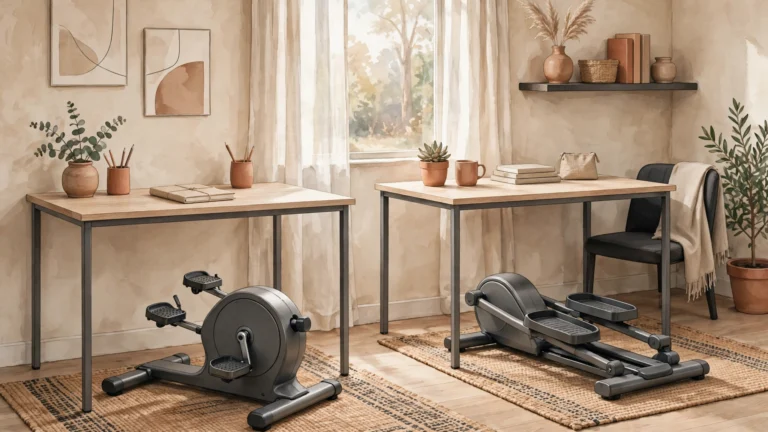
| Cardio equipment | Manufacturer-required operating clearance, access, moving-part travel, and any approved storage procedure |
For the broader room-planning process, use the Home Gym Setup Checklist for Small Apartments. For this purchase, focus on whether you can use and handle the particular equipment as instructed.
Check the supporting surface as carefully as the dimensions. Follow the manufacturer’s requirements for assembly, use, and any permitted mat or support. Do not add unapproved soft layers to make a purchase seem more suitable.
Storage needs the same discipline. Follow the exact instructions for folding, separating, moving, or securing equipment. Do not assume a machine can be stored upright because it appears to balance that way.
A machine’s user-weight rating does not establish the building floor’s capacity. If structural suitability is uncertain, take the candidate’s equipment information to the building owner and an appropriately qualified professional before buying.
Make the final choice around permitted, controlled use
A useful shortlist contains options whose intended use you understand, whose instructions you can follow, and whose claims you can distinguish from assumptions.
Delay or reject a candidate when:
- The intended activity is prohibited or required permission remains unresolved.
- The manual is unavailable, does not match the candidate, or leaves a necessary use or storage question unanswered.
- Use would depend on an improvised anchor, unapproved support, or unsupported storage position.
- You cannot control retrieval, movement, adjustments, or set-downs.
- Structural suitability is uncertain and has not been assessed by the appropriate people.
- Acceptable use depends entirely on an unverified quietness claim or a promised accessory benefit.
- The purchase is difficult to reverse, but important evidence and return conditions remain unclear.
For each remaining option, write down what is known and what is still open. You may know the resistance mechanism, permitted surface, and storage method while still not knowing actual sound at your intended effort, transmission downstairs, or neighbor response. The exact model’s condition and any proposed accessory’s acoustic benefit may also remain unresolved.
Choose only when the documented use fits your space, handling ability, and permissions. If a missing fact could change the decision, resolve that fact before placing the order.