Folding Weight Benches: Check the Workout and the Put-Away Routine
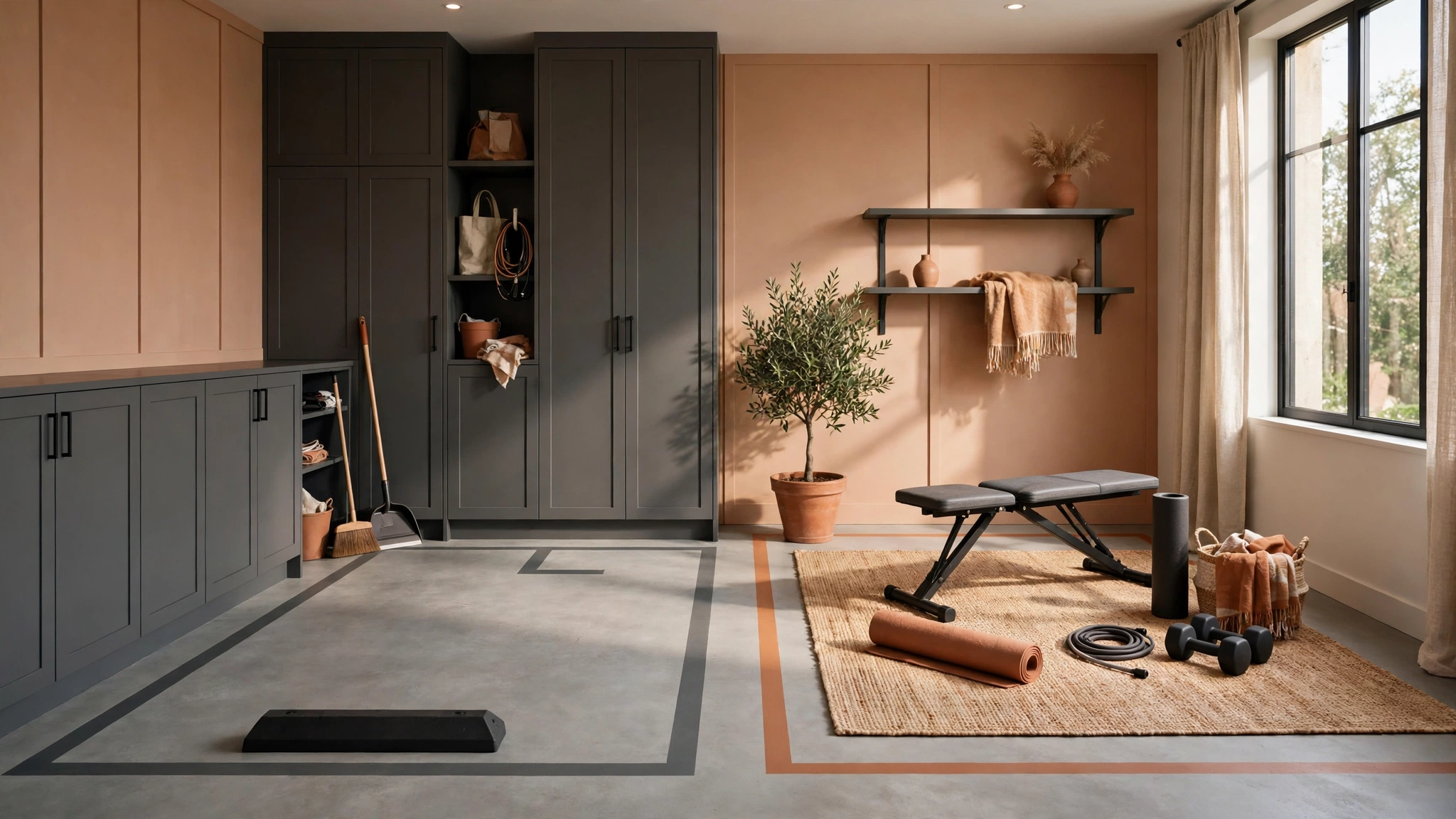
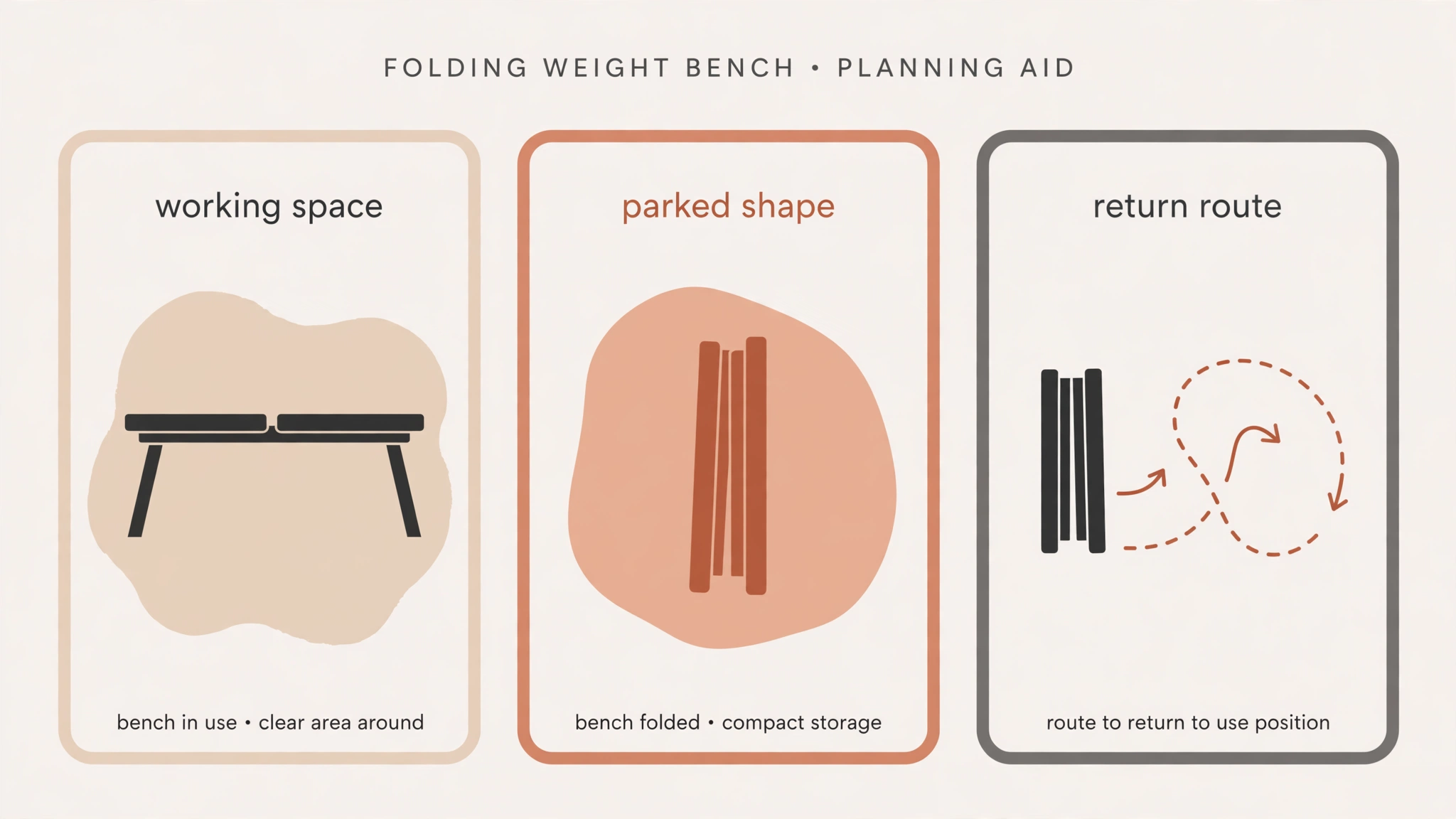
A folding weight bench needs to fit three places: the workout area, its parking spot and the route between them. A small stored footprint solves only one of those problems. Before buying, check the working space and the exact permitted storage position, then decide whether the daily moving routine is realistic for your room.
This guide uses the BowFlex 5.1S as one manufacturer-documented example. It is not a hands-on review or a ranking of every folding bench. The useful question is whether a candidate’s documented requirements work together in your home—not whether its folded photograph looks compact.
Check the working area before the storage gap
Start where you will exercise. Mark the bench’s working outline, then check the surrounding space required by its exact instructions and the equipment you intend to use with it. A clear patch that accepts the bench frame does not automatically provide room to approach it, change position or move the other equipment involved.
Keep three measurements separate:
- Machine dimensions: the bench itself in the stated configuration.
- Working and access space: the additional space required by the applicable instructions and your intended arrangement.
- Stored dimensions: the bench in a specifically permitted parked position.
Do not add a guessed clearance to every bench or borrow another model’s requirement. Equally, do not assume a narrow stored shape tells you anything about the room needed during exercise. If you are still deciding how the whole room will work, use the guide to planning the usable workout area before narrowing the bench shortlist.
Write down which furniture must move for a session and where it will go. A bench that fits only after blocking a doorway or occupying space you cannot actually clear has not passed the layout check. This is a planning screen, not certification that a particular floor or arrangement can support the equipment.
A documented example: BowFlex 5.1S
The BowFlex 5.1S US product page, checked on 20 October 2026, gives separate working and stowed dimensions. Keep the length, width and height labels attached when recording them.
| Manufacturer-listed item | 5.1S figure | What it helps you check |
|---|---|---|
| Machine dimensions | 61.3 in long × 28.1 in wide × 49.5 in high | The stated machine envelope, not a flat-pad height or complete exercise area. |
| Stowed dimensions | 23.9 in long × 28.1 in wide × 52.3 in high | The permitted parked shape needs vertical space as well as floor space. |
| Product weight | 60 lb | A handling consideration, not proof that a particular person can lift or move it easily. |
BowFlex also lists transport wheels. Their presence does not settle a route involving steps or a stair carry. The shorter stowed length does not make the bench thin enough for an arbitrary under-bed gap either: the listed parked height remains a separate measurement to check.
The inspected official 5.1S user guide, revision 8019022.031521.D, recommends 50 inches clear on each side for access and passage. That is guidance from this model’s inspected guide, not a universal clearance rule for folding benches. Obtain the instructions applicable to the exact unit and serial number before deciding that your proposed working area is sufficient.
The 5.1S is therefore a candidate to investigate when its complete working arrangement, tall parked shape and return route can all be accommodated. The specifications alone do not establish personal fit, stability in your room, easy handling or a best-buy recommendation.
Plan the return trip while the bench is still on the shortlist
Measure the storage opening in all relevant directions. Check the height as carefully as the floor rectangle, and account for opening doors, shelves and other objects that would interfere with the actual permitted position. Do not plan to lean, suspend or turn a bench onto a different side merely because that would make it fit.
Also check the space needed to change between the working and stored states. A bench might fit once parked but have no practical place to unfold or reposition it. Use the exact manufacturer’s stowing and moving instructions to evaluate that transition; there is no single folding sequence that should be transferred across models.
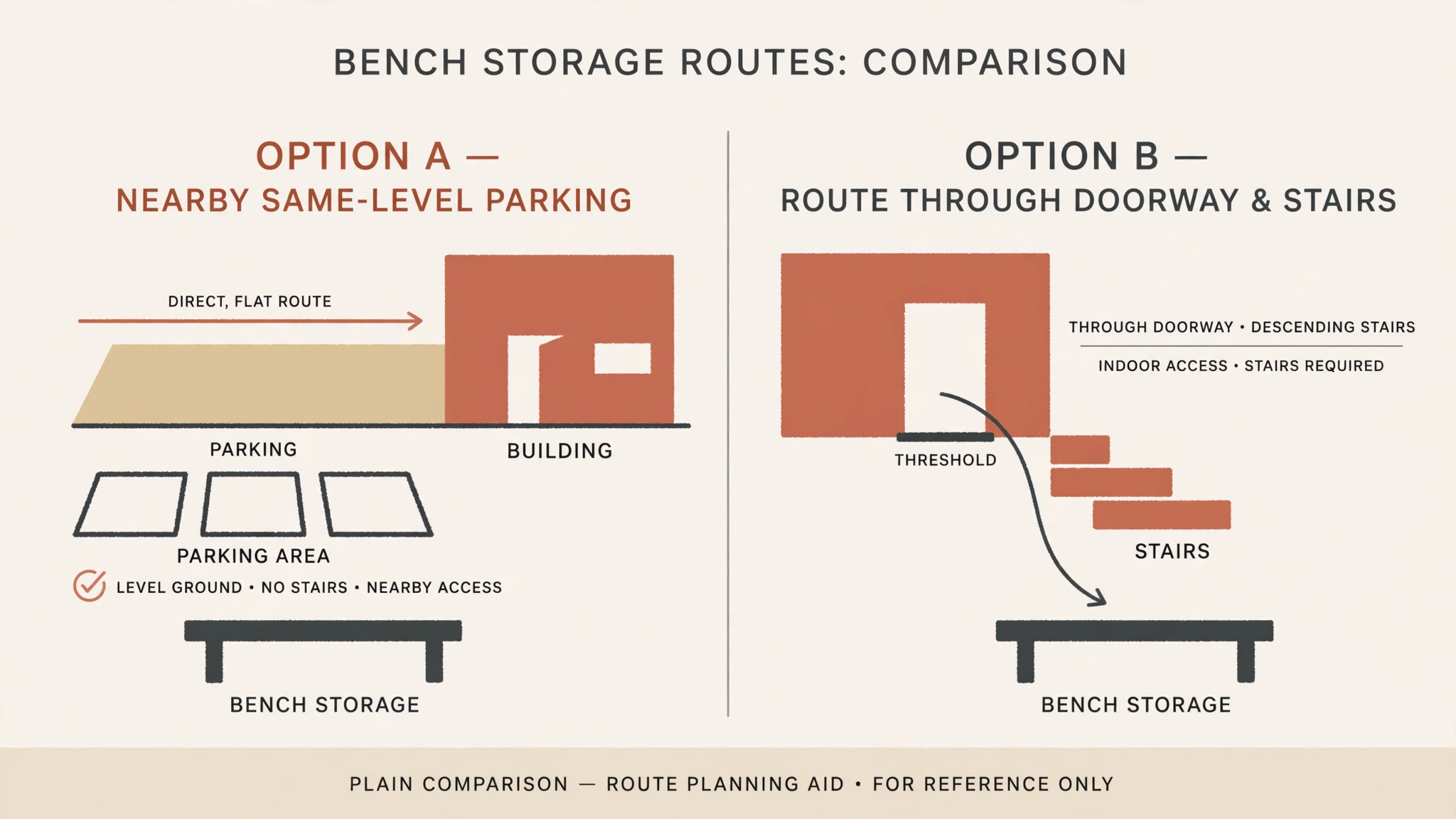
Consider two illustrative rooms. In one, the parking position is near the workout area on the same level, with an unobstructed route. The buyer can investigate whether the prescribed moving and stowing routine is manageable without assuming that wheels guarantee effortless movement.
In the other, the storage destination sits beyond a narrow doorway, a threshold and stairs. The same catalogue measurements leave much more unresolved. The buyer should not treat a wheeled bench as a verified stair-transport solution or assume a safe lifting method. If the required handling cannot be established, keep looking rather than buying on folded size alone.
Neither example is a test result. The point is to evaluate the whole return trip—including the last turn into storage—before making daily put-away part of the purchase plan.
Read the adjustment and load limits before choosing
Compactness does not replace the equipment’s operating requirements. Ask for the exact instructions and check which positions are supported, how the adjustment is secured and what must be checked before use. A missing part or uncertain lock is not a minor inconvenience to solve after purchase.
For the inspected 5.1S guide, the adjustment pin must be fully engaged and the pop-pin knob tightened before use. Its stowing instructions also specify a particular sequence and resting arrangement. These are reasons to read the applicable guide, not a substitute folding or adjustment tutorial. Do not improvise a locking method or infer a permitted storage orientation from product photographs alone.
Read load labels by what they limit. The inspected 5.1S guide states separate maximum user and lifting limits; a combined user-plus-load headline is not a user-only allowance. Check every applicable limit for the exact model instead of treating the largest number as permission for any combination of person and weights. This guide does not prescribe personal lifting loads or provide a capacity calculation for your setup.
If you are considering a used bench, confirm its model, condition, required parts and matching instructions before it becomes a serious candidate. Unresolved damage, missing locking components or uncertainty about the intended configuration should remain purchase blockers, not assumptions hidden behind a low price.
Shortlist, ask or defer based on the whole routine
Use these decisions to finish the screen:
| Decision | When it applies |
|---|---|
| Shortlist | The working arrangement and permitted parked position both fit, and the documented moving routine can be evaluated for the actual route. |
| Ask the manufacturer or seller | The applicable guide, exact model identity, storage position or required components are unclear. Get answers tied to that unit. |
| Defer | The route or handling remains unresolved, required space cannot be kept clear, or locking, condition or use-limit questions remain unanswered. |
A candidate can pass the closet measurement and still fail the everyday routine. Keep the working-space notes, stored dimensions and route checks together. Choose only after those checks agree with the exact instructions; leave an unresolved candidate off the purchase list until its missing requirement is settled.