Choosing a Treadmill Mat to Reduce Noise

A treadmill mat may help with some floor-related noise, but it is not a guaranteed way to stop vibration reaching another apartment. Choose it first as a compatible part of the equipment-and-floor setup, then examine what evidence supports the claimed acoustic benefit. Dimensions and material names do not identify a quietest mat.
Below, two manufacturer-listed products illustrate a specification comparison. Neither has been tested by HomeGymWise, and this is not a ranking of noise performance.
Separate floor protection from noise claims
Write down the problem you want to address: floor protection, equipment contact with the surface, an audible operating sound or disturbance reported elsewhere. These are separate buying goals, even when a listing groups them together.
Horizon’s general noise guidance says a heavy rubber mat may sometimes reduce floor reverberation. It does not quantify a result for the products compared here or approve them for a particular apartment.
If the machine has a new or concerning sound, use its support guidance before buying an accessory as a presumed repair. If a neighbor is affected, keep that observation separate from what you hear beside the treadmill.
Check equipment and floor compatibility
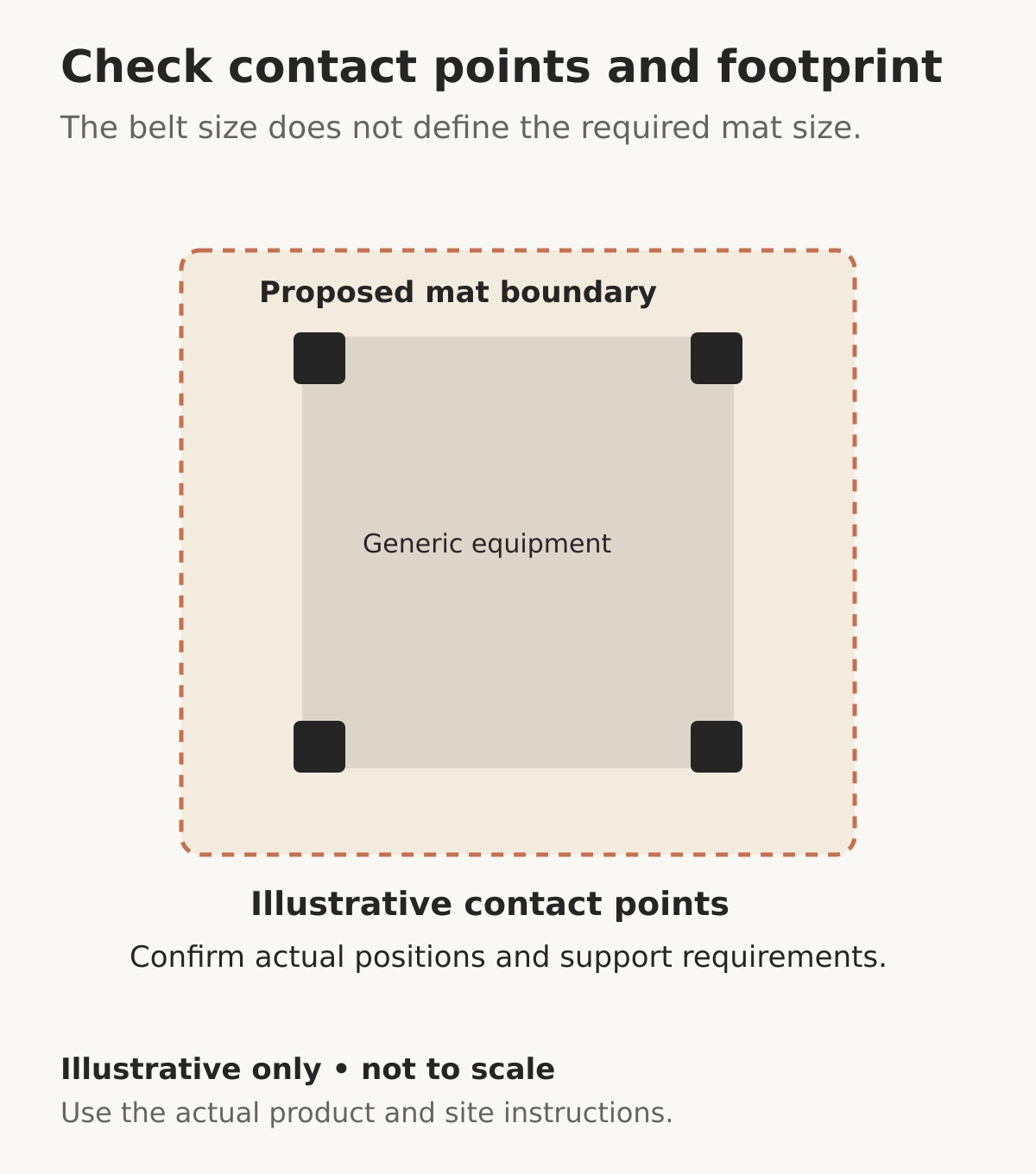
Find the treadmill’s support and surface requirements in its current instructions. Identify where the machine contacts the floor and what the maker requires beneath those points. Do not assume the belt dimensions describe the necessary mat footprint.
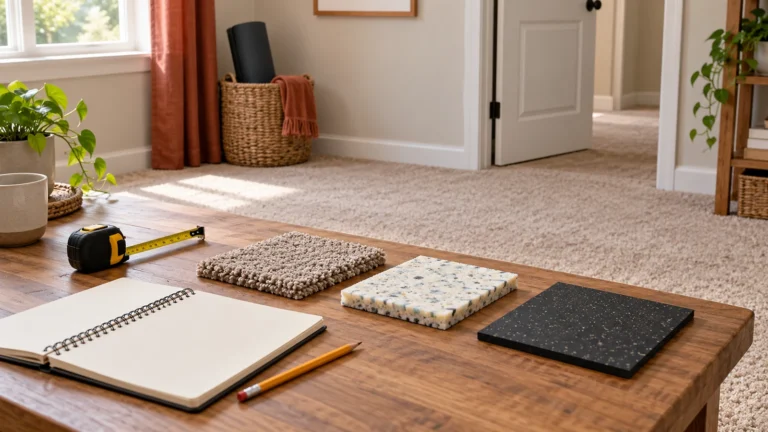
Then identify the underlying finish, any carpet or underlay, and the exact proposed mat. Ask both suppliers about the relevant interfaces. A mat described as floor-protective does not automatically approve every floor finish, and a mat listing does not replace walking-pad or treadmill surface instructions.
Avoid stacking products or improvising a platform to get a desired apparent firmness. Any added layer becomes part of the setup that needs confirmation.
Compare verified mat candidates
The official manufacturer pages identify these two exact products:
| Product | Listed footprint | Listed material and thickness |
|---|---|---|
| Horizon Fitness Mat, SKU HAS0284-01 | 82 inches long by 39 inches wide | Foam; 5 mm thick |
| SuperMats TreadMat 14GS | 36 by 78 inches | Commercial Quality Solid Vinyl; thickness not stated in the inspected variant table |
Specifications were checked on the manufacturer pages on October 16, 2026. Do not substitute another TreadMat item number: the same page lists multiple sizes and material descriptions.
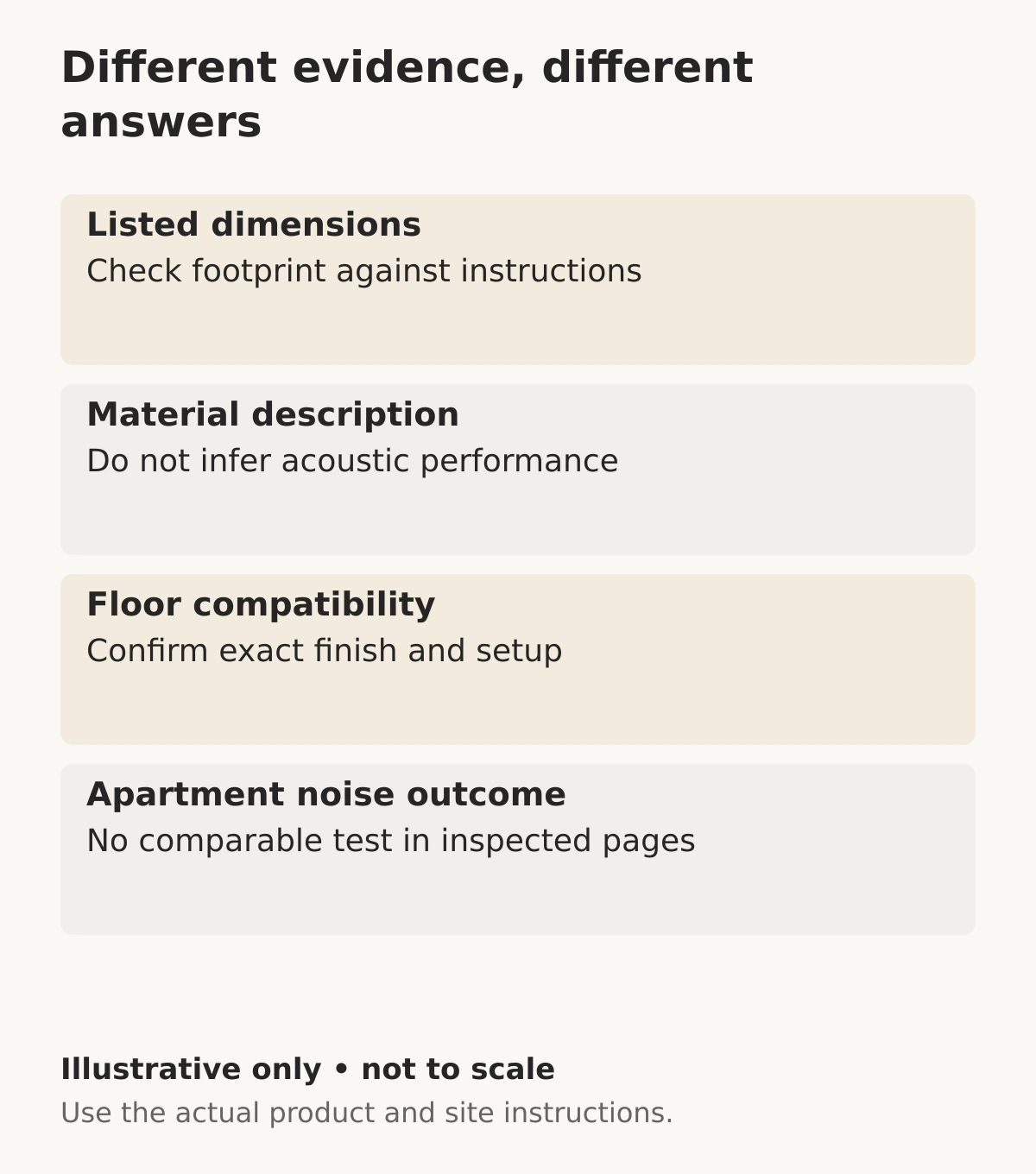
Use the footprints to check dimensional plausibility against the machine requirements and room. The larger listed rectangle occupies more space; that difference does not prove better isolation. Material descriptions are verified labels here, not a basis for an unsupported comfort, stability or noise ranking. Confirm the selected product and actual compatibility before purchase.
Interpret noise and vibration evidence
For any claimed reduction, ask what was measured, with which machine, on which floor, in which receiving location and under what operating conditions. A result from one arrangement may not answer your room’s problem.
The inspected product pages do not provide a comparable acoustic test that establishes which of these two mats is quieter in an apartment. Their noise-related marketing is not treated here as measured proof of a neighbor outcome. Neither is selected as a noise winner.
Do not turn a thickness value, rubber-versus-foam label or price into a decibel estimate. If reducing disturbance is essential, resolve the relevant evidence and building expectations before relying on a mat as the solution.
Choose only after resolving compatibility
Use four columns for your shortlist: exact product/variant, fit against machine requirements, underlying-floor compatibility, and evidence for the specific noise goal. Keep an unknown visibly unknown.
A product can remain a dimensionally plausible candidate while its compatibility or acoustic benefit is unresolved. If you cannot confirm a critical interface, choose another approved arrangement rather than treating the listed dimensions as permission to use it.
For the two examples above, the manufacturer-listed specifications support comparison; they do not settle the actual apartment result. No prices, stock claims, affiliate links or customer-review conclusions are used here. If the main problem is an ongoing disturbance, a separate apartment-noise assessment process may be more useful than repeatedly buying mats without a clear question.